Commercial Licence in Dubai: What It Covers and How to Get One
 Ali Jasim
A commercial licence in Dubai lets you buy, sell, import, export and distribute physical goods under a set of government-approved activities. It is issued by Dubai Economy and Tourism on the mainland, or by a free zone authority, and covers everything from a single-product shop to a broad general trading business.
Getting one means choosing your activities, reserving a name, securing initial approval, signing documents, and paying the fee. A simple licence can be ready in days.
Cost depends on jurisdiction, activities and visas, so price your exact plan rather than trust a headline number.
If your business moves physical products, a commercial licence is almost certainly the one you need.
It is the single most common licence type in Dubai because so much of the economy, retail, wholesale, distribution, import and export, is built on trading goods rather than selling a service.
This guide covers exactly what it lets you do, how to get one, and what it really costs.
What a Commercial Licence Covers
A commercial licence authorises a defined list of trading activities: buying and selling goods, importing and exporting, wholesale and retail distribution, and acting as an agent or distributor for other brands.
It does not cover manufacturing (that needs an industrial licence) and it does not cover selling expertise or services (that needs a professional licence).
If your customer is paying for a product they can hold, ship or resell, you are in commercial-licence territory.

The licence lists the specific activities you are approved for, such as trading in electronics, foodstuff trading, building materials trading, or general trading.
You may only carry out what is written on the licence, which is why activity selection at the start matters more than most founders expect.
Who Needs a Commercial Licence
Retailers, wholesalers, importers, exporters, distributors and most e-commerce stores selling physical products all need a commercial licence. So does a trading company that buys from one country and sells into another without ever touching the goods directly.
If your revenue comes from the margin between buying and selling a product, this is your licence type, whether you operate from a shop, a warehouse, or entirely online.
Commercial vs Professional vs Industrial Licence
Dubai has four main trade licence types and they are not interchangeable. A commercial licence is for trading goods.
A professional licence is for selling expertise, consulting, design, IT, and similar service work. An industrial licence is for manufacturing and production.
A tourism licence covers travel and hospitality. The fastest way to tell them apart is to ask what the customer is actually paying for: a product means commercial, a skill means professional, something manufactured means industrial.
For the full comparison, see trade licence types explained.
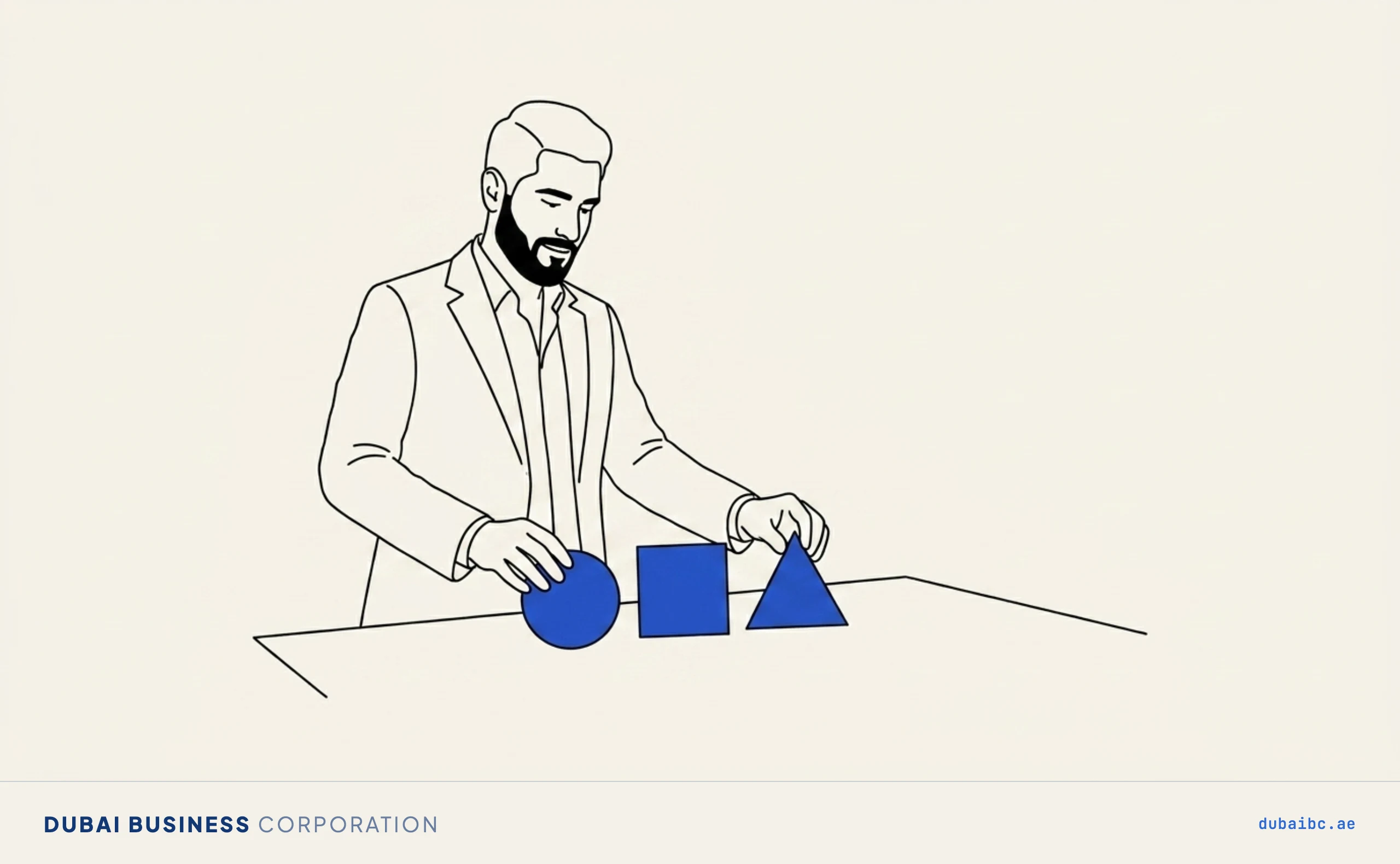
| Commercial | Professional | Industrial | |
|---|---|---|---|
| What is sold | Physical goods | Expertise or service | Manufactured product |
| Typical examples | Retail, wholesale, trading | Consulting, IT, design | Factories, production lines |
| Premises | Shop, office or warehouse | Office or flexi-desk | Industrial facility |
| Extra approvals | For regulated goods | For regulated professions | Almost always required |
How Broad Can One Commercial Licence Go
A standard commercial licence usually covers a related group of activities, for example trading in furniture and home fittings, or trading in electronics and accessories.
If your business genuinely spans many unrelated product categories, a general trading licence is the better fit, since it is designed to hold a much wider basket of goods under one licence rather than forcing you to add activities one at a time.
Mainland or Free Zone for a Commercial Licence
On the mainland, a commercial licence lets you trade anywhere in the UAE, open a real shopfront, and sell directly to local customers and government entities.
In a free zone, the same licence type gives you 100% ownership and often a cheaper, faster setup, but selling directly into the UAE mainland market usually goes through a distributor or a mainland branch.
If your customers are local retail or B2B buyers, mainland is usually the simpler route. If your trade is international or business-to-business within a free zone ecosystem, a free zone commercial licence is often cheaper to start.
Documents You Need
- Passport copies of all shareholders and any manager or general manager appointed.
- Passport-size photographs, usually with a white background.
- Entry stamp or visa page if the applicant is already inside the UAE.
- No-objection certificate from a current UAE sponsor, if applicable.
- Proposed trade name options and the final activity list.
- Tenancy contract or flexi-desk agreement once initial approval is granted.
Step by Step: How to Get a Commercial Licence
- Choose your activities. This decides everything else, including whether any external approval is needed.
- Reserve a trade name. It must follow UAE naming rules and be checked for availability.
- Apply for initial approval. The authority confirms it has no objection to the business, pending any regulated-activity clearance.
- Sign incorporation documents and secure your premises or flexi-desk.
- Pay the licence fee and receive the trade licence itself.
- Apply for the establishment card and any visas you need.
What It Costs
The licence fee depends on jurisdiction, the number of activities, whether any activity needs external approval, and your visa count. A simple free zone licence can start from around AED 12,000, with mainland pricing varying by activity and office size.
Because a headline number is misleading for anyone whose plan differs even slightly, price your exact activities and visa count on the cost calculator instead of assuming a figure from a general guide.
Choose your jurisdiction, activities and visa count. The calculator itemises every fee from the real price book.
Regulated Goods That Need Extra Approval
Some products cannot simply be traded on a standard commercial licence. Food and beverage trading needs Dubai Municipality clearance.
Medical devices and pharmaceuticals need Ministry of Health and Prevention approval. Cosmetics, telecom equipment, and certain chemicals each have their own regulator.
These approvals add time and documents on top of the standard steps, so flag them the moment you know your product category, not after the licence application is already in progress.
General Trading Licence: The Broadest Commercial Option
If you plan to trade across many unrelated product categories, electronics one month, furniture the next, a general trading licence is built for exactly that.
It is still a commercial licence at heart, but it is priced and structured to hold a much wider basket of goods without requiring a separate amendment for every new category.
It suits import-export businesses, trading houses and wholesalers whose product mix changes with demand. Read the full breakdown in general trading licence in Dubai.
How Many Activities Should You Start With
A common question is whether to license one narrow activity or several from day one. The honest answer is to license what you will genuinely do within the next 12 to 24 months, not just what you sell on day one.
Adding one activity later is a paid amendment with its own processing time, so a founder who knows they will expand from electronics into accessories and repair parts within the year is usually better off listing all three activities at incorporation rather than paying for three separate amendments.
The counterweight is that listing activities you have no real plan for can trigger approvals you do not need, or push your licence into a broader, sometimes costlier category than a tightly scoped one would require.
The practical rule is specificity with a small margin: name the exact goods you trade, add the one or two categories you can already see coming, and leave the rest for a future amendment rather than guessing at activities you may never use.
VAT and Tax Basics for a Trading Company
A commercial licence holder is treated the same as any other UAE business for tax purposes. VAT registration becomes mandatory once your taxable supplies pass AED 375,000 in a 12-month period, and voluntary registration is available from AED 187,500 if you want to register earlier, often to reclaim VAT on setup costs and stock.
Corporate tax applies at 9% on taxable profit above AED 375,000, with 0% below that threshold, and Small Business Relief can reduce a qualifying small trading company's taxable income to nil through the end of 2026 if revenue stays under AED 3 million.
None of this changes based on whether you hold a standard commercial licence or a general trading licence, and it applies whether you are on the mainland or in a free zone, though a free zone company earning genuine qualifying income may still access the 0% Qualifying Free Zone Person rate.
For the full detail on how the thresholds work, see UAE corporate tax explained.
Renewing a Commercial Licence
A commercial licence is issued for a fixed period, usually one year, and must be renewed on time. Renewal generally repeats the licence fee and any tenancy or flexi-desk confirmation, without the one-time setup costs.
Missing the renewal window brings fines that increase the longer the licence stays lapsed, and an expired licence can freeze your ability to invoice, renew visas, or operate your bank account.
The full process is covered in how to renew a trade licence in Dubai, and what happens if you miss it entirely is in what happens if your UAE trade licence expires.
Common Mistakes to Avoid
- Selecting activities too narrowly. Cover your near-term plan, not just day one, so you avoid a paid amendment within months.
- Ignoring regulated-activity approvals. Food, medical, cosmetics and telecom products all need external clearance before the licence is issued.
- Assuming a free zone licence lets you sell directly to mainland customers. It usually requires a distributor or branch.
- Underestimating the office-to-visa link on the mainland. Space size decides how many staff you can sponsor.
- Leaving renewal to the last week. Fines start accruing quickly once the licence lapses.
A commercial licence is one of the simplest routes into UAE business, provided the activities match what you will actually sell. Once your activities are set, the rest of the process is largely administrative.
For the wider decision of where to base the company, our mainland and free zone pages walk through the trade-offs in full.
Frequently asked questions
It allows you to buy, sell, import, export and distribute physical goods under the specific activities listed on the licence. It does not cover manufacturing or professional services, which need an industrial or professional licence instead.
It depends on jurisdiction, activities and visa count. A simple free zone licence can start from around AED 12,000. There is no single mainland figure because office size and activity approvals both change the total, so use the cost calculator for an exact number.
Yes, within a related group of activities. If your business spans many unrelated product categories, a general trading licence is designed to cover a much wider basket of goods under one licence without repeated amendments.
Yes. Food trading needs Dubai Municipality clearance, and medical devices or pharmaceuticals need Ministry of Health and Prevention approval. These are added on top of the standard commercial licence process and extend the timeline.
Not usually. A free zone commercial licence trades within its zone and internationally. To sell directly to mainland customers it typically needs a mainland distributor or a branch, which adds cost that should be weighed against a mainland licence from the start.
See the number for your setup
The cost calculator runs on Dubai Business Corporation’s real price book. Answer a few questions and get your total, fully itemised, in under a minute.