When to Get Your UAE Trade Licence: The Founder's Timing Guide
 Ali Jasim
Get your UAE trade licence as close as possible to the first business action that requires it. A trade licence is typically valid for one year from the date of issue, so registering too early means paying renewal fees before revenue arrives. The triggers that make it mandatory are opening a corporate bank account, applying for your own residence visa, signing a formal commercial lease, and issuing compliant invoices under a company name.
Time the issue date to land just before the first of those triggers fires.
Every founder eventually asks the same question: do I need the trade licence now, or can I wait? The answer is not a fixed date.
It is a trigger. Certain business actions in the UAE require an active, valid licence before you can take them, and the goal is to issue the licence just before the first of those triggers fires.
Register too early and you pay renewal fees on a company that is still in planning mode. Register too late and the action you need to take is blocked until the paperwork catches up.
How Long a UAE Trade Licence Is Valid
Most UAE trade licences run on a one-year cycle. The expiry date is printed on the licence document itself, and renewal is due before that date.
Free zone and mainland licences both follow this annual pattern, although some free zone packages offer multi-year options.
The detail that catches founders off guard is that validity is measured in calendar time from the day the licence is issued, not from the day the business first trades or generates its first invoice.

A founder who registers in January and spends five months refining a product before signing a first client has already used nearly half the validity period before the business is active.
When renewal arrives at month twelve, they have paid for a full year but only operated for the back portion of it.
Over several licence cycles, that pattern compounds into a real cost. The right setup date is as close as possible to the first mandatory trigger, with enough lead time to complete the registration process before it fires.
The setup window is not flexible once a trigger date is set. A free zone company is typically registered in 2 to 5 working days once documents are complete.
A mainland company usually takes 1 to 2 weeks. Residence visas add a further 1 to 2 weeks after the licence is issued.
Activities that need external ministry approval, such as healthcare, education, finance, or legal services, take longer still, and the realistic timeline for those categories is something to confirm before committing to a trigger date.
Why Founders Get the Timing Wrong in Both Directions
The instinct to register early comes from a reasonable place. Founders assume the licence signals seriousness to potential clients, or that it is required before they can do anything at all.
In practice, a licence sitting unused is a cost that starts its clock immediately. The renewal arrives whether revenue has or not, and the option to pause the validity clock does not exist.
Getting the timing right means knowing precisely which actions require the licence and which ones do not.

The opposite mistake is registering too late. Some founders assume they can operate informally until a client demands documentation, or that a bank account can wait until revenue is flowing.
The UAE's banking system, immigration authority, and commercial framework all operate around the registered legal entity. Trying to do business without the underlying structure creates gaps that are harder to close after the fact.
The answer is precise timing around the first real trigger, not early and not late.
The Five Triggers That Make the Licence Non-Optional
Planning, researching, prototyping, and having conversations do not require a trade licence. The moment you move from planning to formal business action, the rules change.
The five triggers below are the ones that affect the largest number of early-stage founders in the UAE. Identify which one will fire first in your specific situation, then work backwards from that date when planning your setup.
- Opening a corporate bank account. Every UAE bank requires the trade licence as the anchor document in the account-opening file. Without it, the compliance process cannot begin.
- Applying for your own residence visa. The licence must exist before the visa application can be filed. The visa processing window opens after the licence is issued, not before.
- Signing a commercial lease or flexi-desk agreement. A registered entity with an active licence is the counterparty on a formal commercial agreement.
- Issuing formal invoices. Compliant business invoicing under a company name requires the company to be registered and the licence to be active.
- Connecting a payment gateway. Most payment processors require proof of business registration before activating a merchant account, and many also require a UAE corporate bank account alongside the licence.
Opening a Corporate Bank Account: The Licence Is the First Document They Ask For
The UAE banking system runs deep compliance and KYC checks on every new corporate account.
To open one, you need the trade licence, the memorandum of association or incorporation documents, shareholder passports and Emirates IDs, proof of address, and a business plan or company profile showing the source of funds and expected activity.
The bank then runs its own compliance review before approving the account. The licence is the anchor document in that file, and without it the process cannot begin.

This makes the bank account one of the clearest triggers for licence timing. The sequence is fixed: licence first, then bank account.
And the banking process takes additional time after the licence is issued. A corporate account rarely opens the same week the licence is granted.
Plan for a period where the company legally exists and is incurring costs but cannot yet transact through a company account. That gap is real, and it affects cash flow planning for the first few weeks after setup.
There is also a less visible cost to factor in from the start. Most UAE banks require a maintained minimum balance in a corporate account, and falling below that threshold triggers a monthly charge.
That balance is not a fee in the traditional sense. It is your own money, but money you cannot deploy.
For a small company, it can represent a meaningful portion of early working capital sitting idle for twelve months or more. Budget for it as though it were spent, because operationally it behaves that way for as long as the account is open.
Sponsoring Your Own Residence Visa
A residence visa tied to your own company requires the trade licence to exist before the application can be filed. The sequence is: licence issued, then visa application begins, then the medical test and Emirates ID process follows.
After the licence is in place, visas typically take a further one to two weeks to process.
If a specific residency date is driving the setup timeline, build that full buffer into your planning and count backwards from the target date, not forwards from when it is convenient to start.
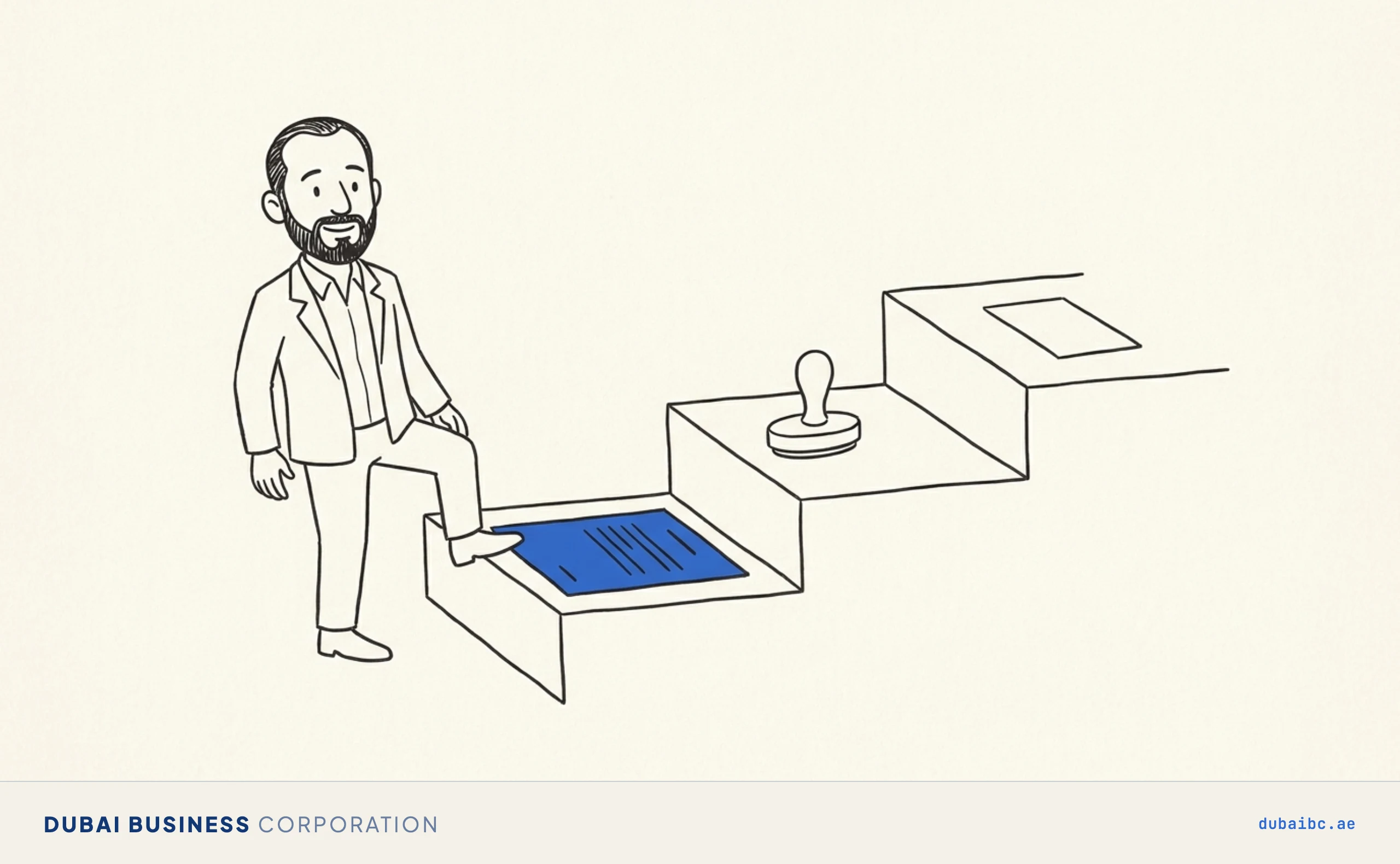
Founders who need to be resident in the UAE before a particular date should treat the visa processing window as fixed and build their setup schedule around it. For a free zone company, setup takes 2 to 5 working days.
For a mainland company, 1 to 2 weeks. The visa adds time on top of the licence issue in both cases.
Activities requiring external ministry approval add more time still. Planning around the realistic window, rather than the fastest theoretical scenario, is what keeps the timeline intact.
Signing a Commercial Lease or Flexi-Desk Agreement
A commercial lease in the UAE is entered into by a registered legal entity, and the trade licence is part of what establishes that entity.
For mainland companies, the setup package includes a one-year virtual Ejari address as part of the formation bundle, which means the address requirement is met during formation rather than as a separate step.
For free zone companies, a flexi-desk or workspace agreement is typically tied to the licence and renews on the same annual cycle.

When renewal comes around, a valid tenancy contract or flexi-desk agreement is one of the documents required before the licence renewal can be processed. The lease and the licence are linked from day one, and that link continues through every renewal cycle.
Understanding this connection early means you are not chasing an expired workspace agreement at the same time as the licence renewal deadline. The two renew together, and one cannot be processed without the other being current.
Issuing Invoices and Connecting a Payment Gateway
Formal business invoicing under a company name in the UAE requires the company to be registered and the licence to be active. The trigger is the invoice itself, not the conversation or negotiation that leads to it.
VAT in the UAE is 5%, and registration becomes mandatory once taxable supplies reach AED 375,000. A business operating below that threshold may not need to register for VAT immediately, but the underlying trade licence is still required for the company to exist as a legal entity capable of entering formal contracts and issuing invoices.
Payment gateways introduce an additional step in the same sequence. Most processors, whether UAE-based or international, require proof of business registration before activating a merchant account.
Some also require an active UAE corporate bank account alongside the licence. If accepting client payments online is part of the business model from day one, the full chain is: licence, then bank account, then payment gateway.
Plan the full chain rather than just the first link, because each step takes additional time after the previous one is resolved.
| Trigger | Licence required? | What else you need first |
|---|---|---|
| Corporate bank account | Yes, it is the anchor document | MOA, shareholder IDs, proof of address |
| Own residence visa | Yes, licence must exist before application | Medical test and Emirates ID process follow |
| Commercial lease or Ejari | Yes, registered entity is the counterparty | Flexi-desk or tenancy agreement |
| Formal invoicing | Yes, for compliant company invoicing | VAT registration if turnover threshold is met |
| Payment gateway | Yes, required by most processors | Corporate bank account in most cases |
The cost calculator uses Dubai Business Corporation’s real price book. Answer a few questions and see your total, itemised, in under a minute.
The Renewal Clock Starts at Setup, Not at Revenue Day
The trade licence starts its twelve-month clock on the day it is issued, regardless of when revenue arrives. A founder who sets up in January and closes a first client in July has only five months of remaining validity when the business becomes active.
Month twelve arrives and the renewal invoice lands at almost the same moment the business finds its operating rhythm. This is the trap: budgeting for setup, then discovering the renewal was already in motion before the first sale.
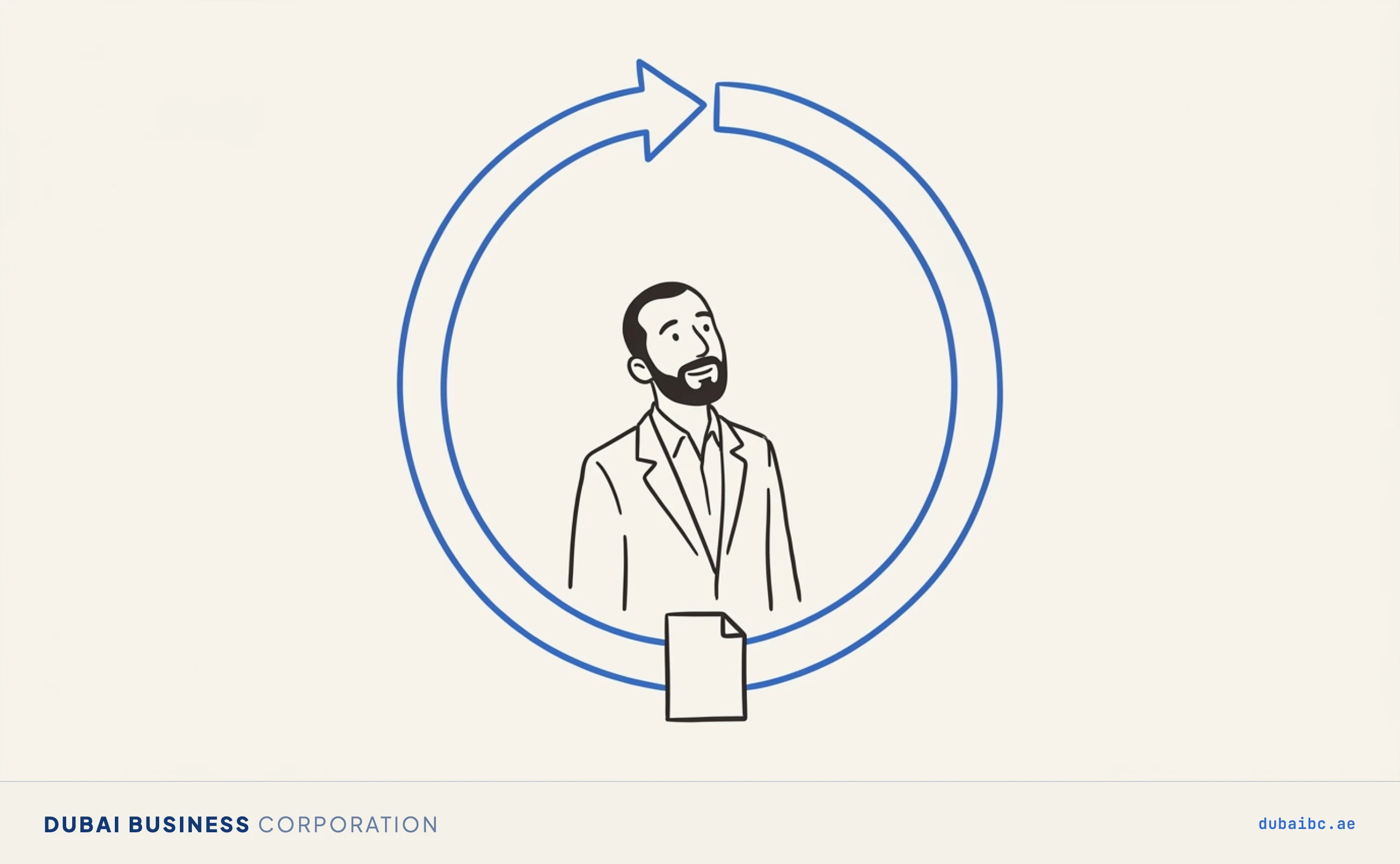
The first year of running a Dubai company has a shape that the setup invoice does not reveal. Setup is one cost.
The bank account minimum balance ties up working capital. Compliance costs run through the year.
And at month twelve, the licence renewal, establishment card, and any visa renewals that fall at the same time can cluster into a significant combined outgoing.
For a detailed picture of how these costs land across the full twelve months, see what a Dubai company actually costs in year one.
Treat the renewal as a known, recurring line item in your business plan from the day you set up, not as a surprise that arrives eleven months later.
The renewal cost is generally lower than the original setup cost because it strips out one-time items like initial approval and name reservation.
But it repeats every single year without exception. The right mental model is a subscription with a hard annual deadline, not a one-time purchase with an optional extension.
What an Expired Licence Does to the Business
An expired trade licence is not a paperwork technicality. It affects the whole business at once.
Banks can freeze or restrict a corporate account tied to an expired licence. Visa applications and renewals for anyone sponsored under the company stop.
Government portals may block other transactions, including amendments, new approvals, and activity changes, until the licence is made current again. The company does not quietly continue while the renewal is delayed.

The consequences escalate the longer the licence stays unrenewed. Most authorities move through a sequence: accumulating fines, then suspension of the licence, then eventual cancellation if the situation is left unresolved long enough.
A suspended licence also affects the status of every visa sponsored under it, since the sponsoring entity is no longer active. In serious cases the licence can be blacklisted, which creates a more complex resolution path than a straightforward late renewal.
For the full picture of what an extended lapse does to the company and its visas, see what happens if your UAE trade licence expires.
The Grace Period Is Not a Strategy
Most UAE free zones offer a short grace period after the official renewal date, giving the company a limited window before penalties escalate. Founders sometimes treat this like a subscription service that quietly continues for a few months after the billing date.
In practice, the grace period is measured in weeks, not months. Fines typically begin accruing from the missed deadline itself, not from the end of the grace period.
The grace period is an emergency buffer and nothing more.
The practical problem with relying on the grace period is that resolving a late renewal is rarely as simple as paying the renewal fee.
An expired tenancy contract, outstanding fines from a previous period, or a lapsed approval tied to a regulated activity can each block the renewal from being processed.
Each of those needs to be resolved before the licence can renew, and each resolution adds time. By the point these surface during a rushed late renewal, the grace period may already be consumed.
How to Read the Dates on Your Licence
The expiry date is printed on the licence document itself. This is the date to track, not your memory of when the company was originally formed.
Amendments made partway through a licence year, such as an added activity, a shareholder change, or an address update, do not always shift the expiry date.
Occasionally these changes are bundled with a renewal in a way that does affect the date, but that is worth confirming directly with the authority or your formation agent rather than assuming.
The practical approach is to mark the expiry date in a calendar on the day the licence is issued, then set reminders at the sixty-day and thirty-day marks. Sixty days provides time to identify complications before they become urgent.
Thirty days is the working deadline to have documents ready to submit. Starting a month early avoids the document-gathering delays that cause most late renewals.
It is the preparation phase, not the submission transaction, that takes the most time.
Building Licence Timing Into Your Business Plan
The right time to get a UAE trade licence is the moment the first mandatory trigger is in sight. Map the trigger first, then work backwards from it to set the setup date.
If the first trigger is a bank account and the account takes additional time to open after the licence is issued, the licence needs to be in place earlier than the date you need the account active.
If the trigger is a visa, the licence and the visa window together set the date.
The sequence is always: licence first, then the action it enables.
The variables that affect the ideal setup date include the jurisdiction, the activity, and whether a residence visa is needed and when. The cost of the licence itself depends on those same factors.
For a mainland company, the all-in range runs from roughly AED 17,772 to AED 28,287 depending on activity type, ownership structure, and whether a visa is included. A free zone company can start from around AED 12,000 for a simple configuration without visas.
For a current figure on your specific situation, use the cost calculator rather than relying on general ranges, since the actual number depends on the details.
Getting the Sequence Right From the Start
The sequence is: licence, then the action the licence enables, then the next step after that. For most early-stage founders in the UAE, the chain looks like this.
Issue the licence just before the first trigger. Open the bank account after the licence is in place.
Process the residence visa once the licence exists. Connect payment infrastructure once the bank account is active.
Each step depends on the one before it. Knowing where your first trigger sits in that chain tells you exactly when the licence needs to be issued.
Activities that need external approvals beyond standard registration add time to the front of that chain, and knowing the realistic window for your specific activity is worth confirming before you commit to a trigger date.
The trade licence services page covers how DBC prepares the formation file, which external approvals apply to which activities, and what to expect at each step of the process.
Business registration and visa processes in the UAE are governed by UAE government services, with Dubai immigration specifically handled by GDRFA Dubai. Employment visa and work permit processes fall under MOHRE.
Frequently asked questions
A UAE trade licence is typically valid for one year from the date of issue. The exact expiry date is printed on the licence document itself. Some free zone packages offer multi-year options, but the standard cycle across mainland and most free zones is annual. Renewal is due before the expiry date. Fines begin accruing once the deadline passes and escalate if the licence stays unrenewed for an extended period.
You can research, plan, prototype, and have business conversations without a trade licence. The moment you move to a formal business action, the rules change. Opening a corporate bank account, applying for a residence visa, signing a commercial lease, issuing formal invoices under a company name, and connecting a payment gateway all require an active licence. Operating commercially without one means the underlying company does not exist as a legal entity, which creates complications that are harder to resolve after the fact than to avoid from the start.
The twelve-month validity clock starts on the day the licence is issued, not on the day you begin trading. A founder who registers in month one and closes a first client in month seven has used half the validity period before the business is active. The renewal invoice arrives at month twelve regardless of trading activity. The goal is to time the issue date as close as possible to the first business trigger, with enough lead time to complete setup and any additional steps such as bank account opening or visa processing.
The cost depends on the jurisdiction, the activity, and whether a residence visa is included. A mainland company typically runs from roughly AED 17,772 to AED 28,287 all in for common setups. A free zone company can start from around AED 12,000 for a simple configuration without visas. The cost does not change based on when in the year you register, so timing decisions are about trigger mapping rather than price optimisation. Use the cost calculator for an accurate figure on your specific activity and structure.
Mark the expiry date printed on the licence in a calendar on the day it is issued, then set reminders at the sixty-day and thirty-day marks before the deadline. Start the renewal process at least a month before expiry, since gathering documents such as a current tenancy or flexi-desk agreement and clearing any outstanding fines can each take longer than the renewal transaction itself. An expired licence triggers immediate fines and can block bank operations, visa renewals, and government approvals until it is fully resolved.
See the number for your setup
The cost calculator runs on Dubai Business Corporation’s real price book. Answer a few questions and get your total, fully itemised, in under a minute.