General Trading Licence in Dubai: Sell Almost Anything Under One Licence
 Ali Jasim
A general trading licence in Dubai is a broad version of a commercial licence that allows a company to trade in a wide range of unrelated product categories, electronics, furniture, foodstuff, textiles and more, under a single licence rather than adding activities one at a time. It suits import-export businesses, wholesalers and trading houses whose product mix changes often.
A handful of restricted goods, arms, certain chemicals, narcotics and similarly controlled items, are always excluded regardless of licence type. Cost and setup steps mirror a standard commercial licence, with the activities list simply being wider.
Most commercial licences group activities around a related theme: electronics trading, or furniture trading, for example. A general trading licence exists for businesses that do not want that constraint, because their product mix genuinely spans many unrelated categories and changes with demand.
It is one of the most requested licence types in Dubai precisely because trading houses rarely deal in only one thing. Here is what it actually covers, who should choose it, and what it costs.
What a General Trading Licence Covers
A general trading licence authorises trading, importing, exporting and distributing across a broad spread of product categories, rather than one theme.
A single licence holder might legitimately trade electronics one quarter and home furnishings the next, without filing a fresh amendment every time the product mix shifts.
This is the core appeal: flexibility for a business model built on opportunity and margin rather than a fixed catalogue.

It remains, at its core, a commercial licence. The activities are still listed on the licence and still government-approved; the difference is breadth, not a different legal structure or authority.
Who Should Get a General Trading Licence Instead of a Standard Commercial One
If your business trades in one or two related product lines, a standard commercial licence with those specific activities is usually simpler and, in some jurisdictions, cheaper.
A general trading licence earns its cost when your product range is genuinely wide or unpredictable: import-export operators sourcing whatever sells, trading houses serving multiple retail clients, and distributors who add and drop product lines as opportunities appear.
- Import-export companies sourcing and reselling across varied categories.
- Wholesale distributors serving retailers across multiple product types.
- Trading houses that pivot product focus with market demand.
- Businesses testing new product categories without wanting a fresh amendment each time.
How Many Activities Can Sit on One Licence
General trading licences are structured to hold a large number of trading activities, far more than a themed commercial licence would typically include. That said, "general" does not mean unlimited or unregulated.
Certain activities still require external approval regardless of how broad the licence is, and a few categories are excluded outright no matter what type of trading licence you hold.
Products That Are Excluded or Restricted
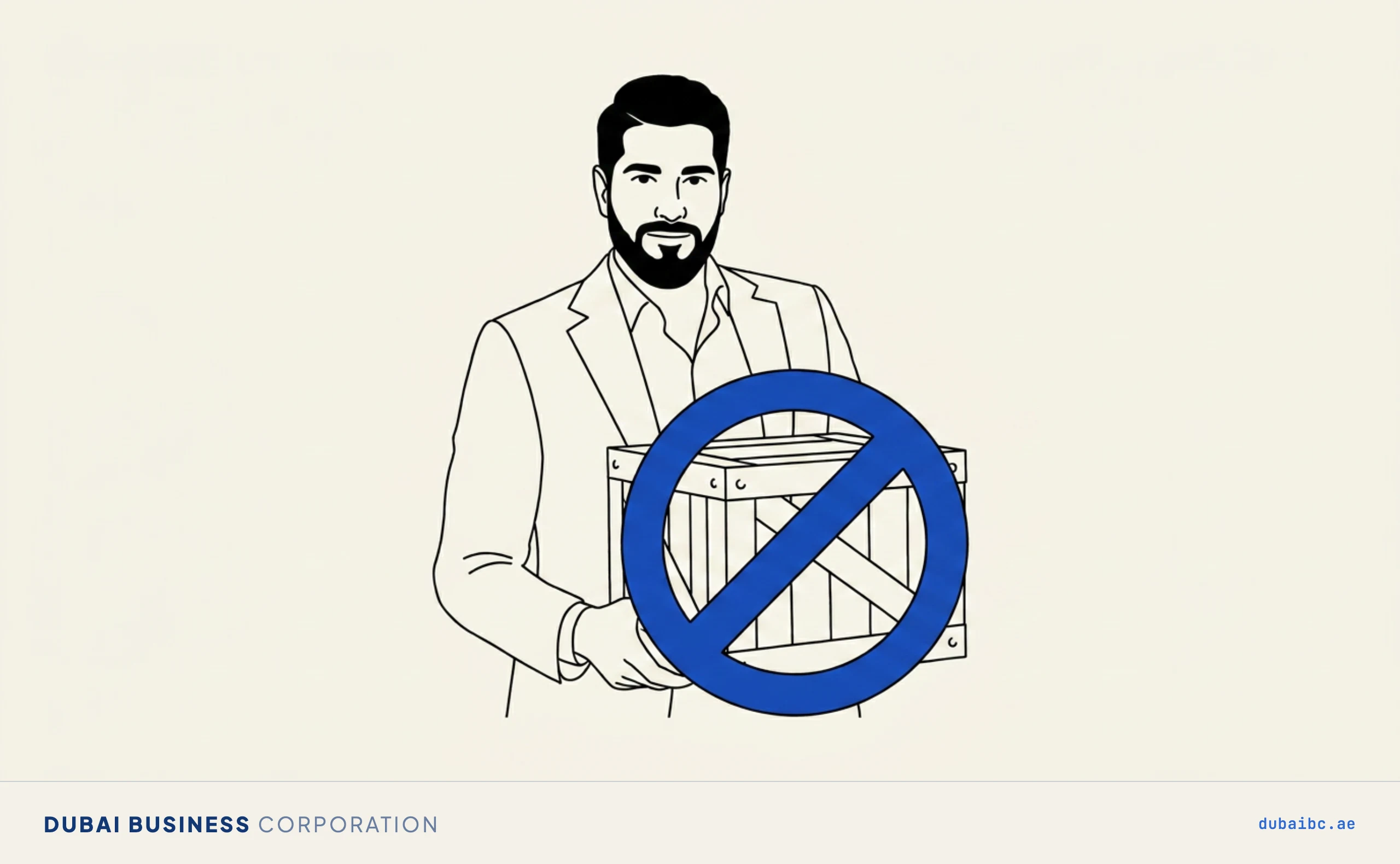
A short list of goods sits outside any UAE trading licence, general or otherwise: firearms and weapons, narcotics and controlled substances, and certain hazardous chemicals fall under separate, tightly controlled regulatory regimes rather than standard commercial licensing.
Other categories are not excluded but are regulated on top of the licence: food and beverage products need Dubai Municipality clearance, and pharmaceuticals or medical devices need Ministry of Health and Prevention approval.
A general trading licence does not bypass these; it simply avoids the need for a fresh licence amendment every time you add a new, unregulated product line.
Mainland vs Free Zone General Trading
On the mainland, a general trading licence lets you sell directly to any UAE customer and warehouse goods anywhere in the emirate, which suits a business supplying local retailers and distributors.
In a free zone, the same broad licence type is common and often cheaper to start, particularly for businesses whose customers are overseas buyers or other free zone companies, but direct mainland sales typically require a distributor or branch, the same trade-off that applies to any free zone commercial activity.
| Mainland | Free zone | |
|---|---|---|
| Sell directly to UAE retailers | Yes | Via distributor or branch |
| Warehouse location | Anywhere in the emirate | Within or near the zone, or bonded facilities |
| Setup speed | Slightly longer | Often faster |
| Best for | Domestic wholesale and distribution | Import-export and international trade |
Documents You Need
- Passport copies of all shareholders and the appointed manager.
- Passport-size photographs on a white background.
- Detailed activity list covering every product category you plan to trade.
- No-objection certificate from an existing UAE sponsor, if applicable.
- Warehouse or office tenancy contract, once initial approval is granted.
- Import-export code registration, arranged after the licence is issued.
Step by Step: How to Get One

- List every product category you plan to trade, not only the ones you start with.
- Reserve your trade name under standard UAE naming rules.
- Apply for initial approval, flagging any category that needs external clearance.
- Sign incorporation documents and confirm your office or warehouse.
- Pay the licence fee and collect the trade licence.
- Register for an import-export code if you plan to clear goods through customs directly.
What It Costs
A general trading licence follows the same cost buckets as any commercial licence: the fee itself, workspace, the establishment card, and visas.
The width of the activity list generally does not multiply the base licence fee the way people expect, since it is priced as a licence category rather than per activity.
What does move the number is jurisdiction, warehouse or office size, and visa count, exactly the factors that decide any UAE licence cost. Price your specific plan on the cost calculator to see the real, itemised figure.
Add your jurisdiction and visa count and see the itemised cost from the real price book, no rounded estimates.
Import and Export Considerations
A trading business moving goods across borders typically needs an import-export code registered with UAE Customs, in addition to the trade licence itself.
Bonded warehousing, available in several free zones, can defer customs duty until goods actually enter the local market, which matters for re-export businesses that hold stock temporarily before shipping it onward.
If cross-border logistics is central to your model, factor customs registration and warehousing into your setup timeline from the start, not as an afterthought once the licence is issued.
VAT and Customs Duty for General Trading
A general trading company is subject to standard 5% VAT on the same terms as any other UAE business, mandatory registration once taxable supplies pass AED 375,000 and voluntary from AED 187,500. Import VAT is generally accounted for at the point of customs clearance, and a registered business can typically recover it through the standard VAT return process rather than treating it as a sunk cost.
Customs duty, separately, is usually charged as a percentage of the goods' value on entry into the UAE market, though goods held in a bonded or free zone warehouse for re-export can often defer or avoid that duty entirely, which is one of the more valuable structuring decisions a trading business can make early.
None of this replaces good bookkeeping. A general trading company moving stock across many categories and jurisdictions benefits more than most from clean, contemporaneous records of what was bought, what was sold, and where each shipment physically sat at each stage, since this is exactly the kind of paper trail a customs or VAT audit will ask for first.
Building Supplier Relationships and Compliance Checks
A trading business is only as reliable as the suppliers behind it, and a general trading licence makes it tempting to add a new product line the moment a supplier offers good terms.
Before doing so, it is worth running the same basic checks every time: confirming the supplier's own registration and standing, checking whether the product category needs any additional approval you have not yet obtained, and understanding the shipping and documentation requirements for that specific category.
Skipping this step to move fast is where most avoidable customs delays and compliance issues start.
Insurance and Cargo Risk
A trading business carrying stock, whether in its own warehouse or in transit, faces risks a pure service business does not: goods damaged in shipping, a warehouse fire or flood, or theft from a storage facility.
Marine cargo insurance covers goods in transit and is standard practice for any business genuinely importing and exporting rather than buying and selling locally.
Warehouse and stock insurance covers the goods once they land, and public liability cover protects against claims arising from the physical handling of your products.
None of these are usually mandatory for the licence itself, but skipping them is a common way a single bad shipment turns into a serious financial setback rather than a manageable one.
Renewing a General Trading Licence
A general trading licence renews annually like any other UAE trade licence, and because the activity list tends to be wide, renewal is also a sensible point to review whether every listed category is still relevant to the business or whether some have gone unused for years.
Trimming an activity list at renewal does not usually cost extra and can simplify future compliance checks, while adding a new category you have started trading in keeps the licence honest about what the business actually does.
The general renewal process, documents and timing are covered in how to renew a trade licence in Dubai.
Common Mistakes to Avoid
- Under-listing product categories at setup. A general trading licence is meant to be broad; use that breadth from day one.
- Assuming "general" removes regulated-goods approvals. Food, medical and telecom categories still need external clearance.
- Skipping the import-export code when the business genuinely clears customs directly.
- Choosing free zone for a mostly domestic wholesale business. The distributor step can outweigh the setup saving.
- Confusing "general trading" with a licence to sell restricted goods. Arms, narcotics and controlled chemicals remain excluded regardless.
A general trading licence is the right choice when your business genuinely trades across categories rather than within one. If your product range is narrower, a standard commercial licence with specific activities may serve you just as well for less complexity.
Either way, the setup mechanics, and the real cost, are best confirmed against your exact plan rather than a generic figure.
Frequently asked questions
It is a broad type of commercial licence that lets a company trade across a wide range of unrelated product categories under one licence, instead of adding a fresh activity or amendment for each new product line.
Firearms, narcotics and certain hazardous chemicals are excluded from any UAE trading licence, general or otherwise. Food, medical devices and similar categories are not excluded but require separate external approval on top of the licence.
Not necessarily. The width of the activity list is usually priced as a licence category rather than per activity. What moves the total cost is jurisdiction, office or warehouse size and visa count, the same factors that affect any commercial licence.
Not usually without a distributor or a mainland branch. This is the same trade-off that applies to any free zone commercial licence, so it is worth weighing against a mainland setup if most customers are local.
If your business clears goods through customs directly, yes. It is registered with UAE Customs separately from the trade licence itself and is a standard step for import-export operators and wholesalers moving stock across borders.
See the number for your setup
The cost calculator runs on Dubai Business Corporation’s real price book. Answer a few questions and get your total, fully itemised, in under a minute.