How to Start a Catering Business in Dubai
 Ali Jasim
A Dubai catering business needs a mainland trade licence with a catering activity, an approved central production kitchen, and Dubai Municipality food safety approval covering both the kitchen and the way food is transported. Catering is regulated more tightly than a restaurant in one respect: the food leaves your premises and is served somewhere you do not control, so temperature control, transport and event permits carry real weight.
Catering looks like a lighter version of a restaurant because there is no dining room, and that is exactly the wrong way to think about it. A restaurant serves food metres from the pass.
A caterer cooks in one place and serves in another, often hours later, often outdoors, in a country where outdoor means forty degrees for several months of the year. Dubai Municipality regulates catering with that gap firmly in mind.
What Kind of Catering You Are Actually Doing
The word covers several very different businesses, and the licence and premises follow the model you choose.
- Event and wedding catering. Large volumes, irregular schedule, heavy transport and on-site service.
- Corporate and office catering. Daily volumes, predictable, tight delivery windows.
- Labour camp and staff catering. Very high volume, contract based, and the most heavily inspected.
- Home and small party catering. Small volumes, and the segment most often operating unlicensed.
- Airline and institutional catering. Specialised, with additional standards on top of the municipality regime.
The regulatory core is identical across all of them: an approved kitchen, trained handlers, controlled transport. What changes is scale, contract structure and how much of your cost sits in logistics.
The Licence and Where It Comes From
Catering services are licensed by the Department of Economy and Tourism as a mainland activity, with Dubai Municipality approving the food operation itself.
Most activities of this type permit 100% foreign ownership, so a foreign founder does not need a local partner for the shareholding.

You will hold two things that people often confuse: a trade licence, which is your right to trade, and a food establishment permit from the municipality, which is your right to produce food at those specific premises. Both renew, on their own cycles, and losing either stops the business.
The Production Kitchen
This is the centre of the business and the centre of the approval. The kitchen has to sit in an area zoned for food production, usually an industrial or approved commercial zone rather than a residential tower, and the layout is approved by Dubai Municipality before construction.
What they look for is flow: raw goods in one door, storage separated by product type, preparation areas that do not cross contaminate, cooking, chilling, and finished goods out.
Add hand wash stations in the right places, correct extraction, a grease trap, pest proofing and calibrated temperature monitoring, and you have most of the inspection sheet.
Transporting Food Legally
Food moving from your kitchen to a venue must stay at the correct temperature and be protected from contamination. That means insulated or refrigerated vehicles appropriate to the food type, with the vehicle itself registered and approved for food transport.
Uncontrolled boots of private cars are not an accepted method for commercial catering.
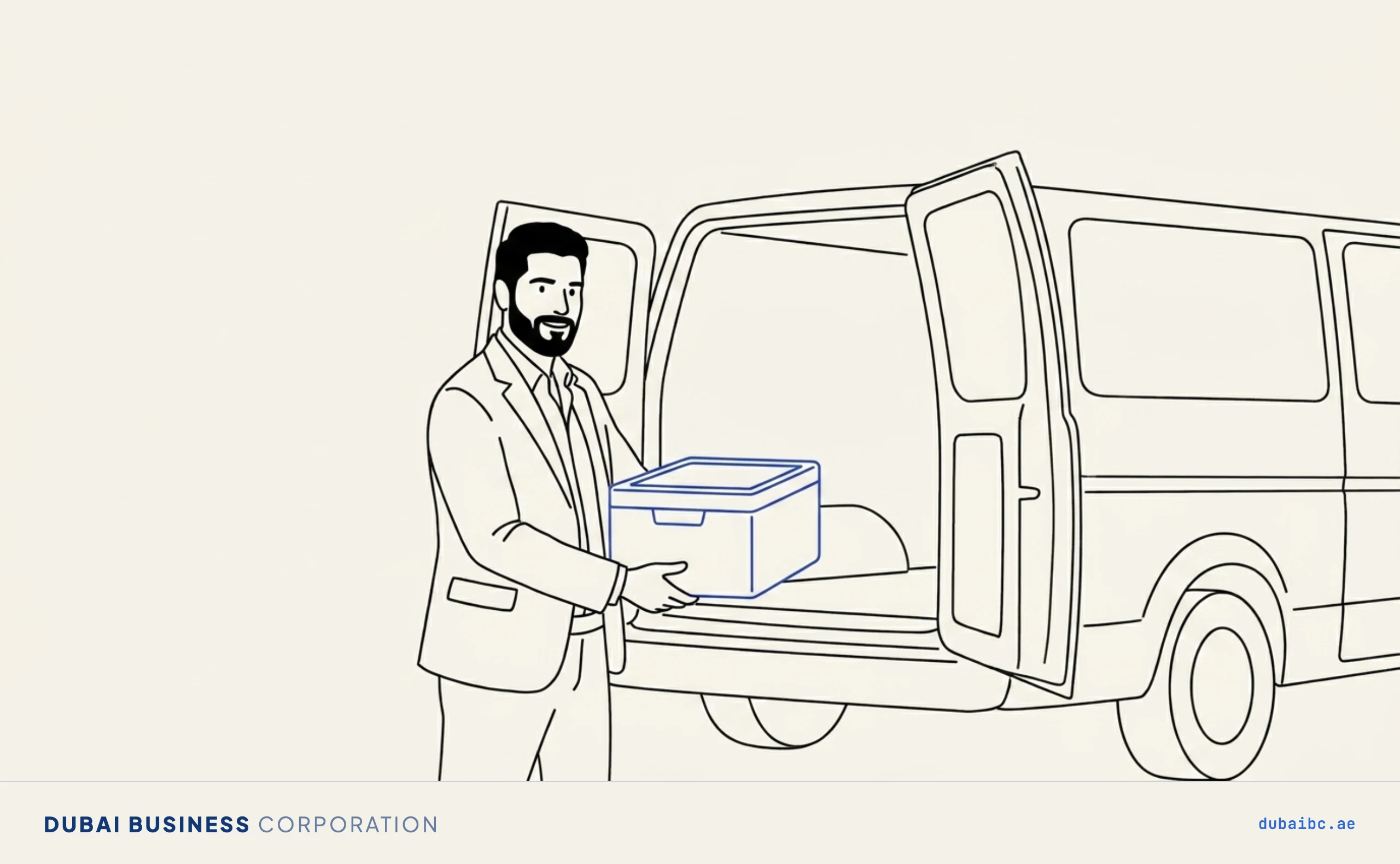
Practically, this means budgeting for vehicles as part of setup rather than as an afterthought, and building temperature checks into the loading routine so the log exists if an inspector asks for it.
Get the mainland licence, approvals and visa fees itemised from the real fee schedule.
Event Permits and Serving Off-Site
Catering a private dinner in a home is one thing. Catering a public event, a festival or a large gathering usually pulls in event permitting, and the organiser normally holds that permit while requiring their caterer to hold valid municipality approval.
Venues will ask for your food establishment permit and your handlers' cards before they let you through the loading bay.
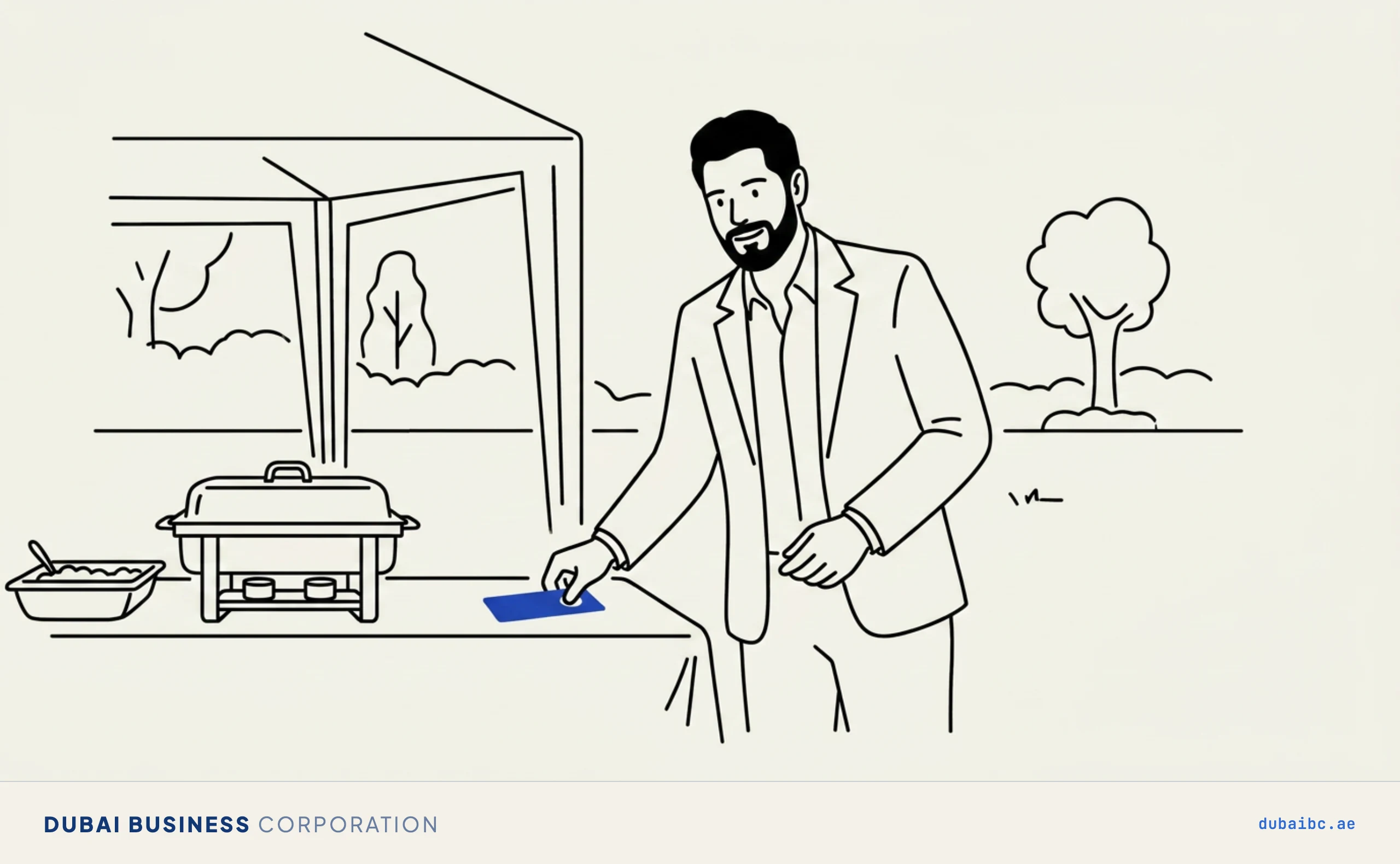
Keep a compliance pack ready as a matter of routine: trade licence, food establishment permit, food handler cards, vehicle approvals and public liability insurance. Contracts are won and lost on how quickly you can produce it.
Food Handler Training
Every person who touches food in your operation must complete the Dubai Municipality approved food handler training and hold the resulting card, and your business needs a nominated person responsible for food safety.
This is not a formality: inspections check cards, and an untrained handler on site is a finding against the establishment, not against the individual.
Because catering staffing flexes with the event calendar, build the training into onboarding so a rush booking never forces you to put an uncarded person on the line.
What It Costs to Start
| Nature of the cost | Notes | |
|---|---|---|
| Company and licence | One off, then annual | Knowable exactly |
| Kitchen premises | Annual rent plus fit out | Largest variable |
| Equipment | One off | Scales with menu and volume |
| Vehicles | One off or leased | Must be food-approved |
| Visas and staff | Per person, annual | See the calculator |
| Working capital | Ongoing | Event terms can be slow |
The licence and visa side is fixed and can be priced exactly using our cost calculator. The kitchen is where the range is enormous, from taking a slot in an existing approved facility to building your own unit.
Our mainland cost breakdown covers the fixed elements.
Staffing and Visas
Catering is labour heavy and seasonal, which is an awkward combination in a country where staff come with residence visas. You will need chefs, kitchen staff, drivers and service staff for events.
Each employee needs a work permit from MOHRE, a residence visa, and salary paid through WPS.
Event service staff are often supplied by licensed manpower companies, which is legal and sensible when demand is lumpy. Supplying labour yourself is a separately licensed activity, so do not drift into it informally.
See what it costs to hire your first employee for the real per head numbers.
Tax and Contracts
Catering supplies carry 5% VAT, and registration is mandatory above AED 375,000 of taxable supplies. Corporate events usually mean corporate customers, which means invoices, credit terms and slow payers.
Build a deposit into the contract, price the payment terms in, and keep the VAT position clean from the start. See VAT registration and corporate tax.
Common Mistakes
- Cooking from an unlicensed kitchen and calling it a home business.
- Choosing premises before checking the zoning and the municipality layout requirements.
- Transporting hot food in private cars, which fails both the rules and the food.
- No temperature logs, which turns a good kitchen into a failed inspection.
- Pricing per head without costing transport, labour and waste for that specific event.
- Accepting long payment terms on an event business that pays its suppliers immediately.
Winning and Keeping Contracts
Catering revenue comes in two very different shapes. Event work is high value, unpredictable and won on presentation and reputation.
Contract work, meaning a company, a school or a workforce that eats with you every day, is lower margin per head and transforms the business, because it turns a lumpy order book into a base load that covers your fixed costs.

Most successful Dubai caterers build the contract base first and treat events as the upside. Contracts are won on tender, and tenders ask for exactly the documents listed earlier plus references, insurance and often a site visit to your kitchen.
A kitchen that looks like it would pass an unannounced inspection wins tenders. One that does not, does not, regardless of the food.
Price contract work carefully. A per head rate agreed for a year with no ingredient escalation clause is a bet on commodity prices, and it is a bet caterers regularly lose.
Build a review point into the contract rather than absorbing the difference quietly.
Insurance and Liability
Catering carries a real tail risk: a food safety incident at an event with hundreds of guests is both a health matter and a commercial one.
Public liability insurance is expected by most venues and corporate clients, and product liability cover specific to food is worth having rather than assuming your general policy addresses it.
Alongside insurance, keep traceability. Knowing which supplier delivered which batch on which day, with the delivery temperature recorded, is what turns a potential crisis into a contained investigation.
It is also exactly what an inspector or a client's auditor will ask for first.
Is catering a good business in Dubai?
The demand is real and permanent. Dubai runs on events, corporate hospitality and a very large workforce that eats catered food daily.
Margins are workable for operators who control food cost and logistics, and dreadful for those who do not, because every mistake travels with the delivery van.
Start with one segment rather than all five. A caterer known for corporate lunches can add events later.
A caterer who does everything badly for everybody has no reference customer to grow from.
A realistic first eighteen months looks like this. Secure a kitchen you can afford at low volume, ideally shared space rather than your own unit, and get the licence and permits clean.
Win one anchor contract that covers rent and core wages, even at a modest margin, because that contract buys you the stability to be selective about everything else.
Then layer event work on top, where the margin actually is, using the contract kitchen you are already paying for.
The operators who struggle usually invert that order. They build an expensive kitchen for the events they hope to win, carry the fixed cost through a quiet summer, and discount their way into contracts that never quite cover the overhead.
The equipment did not cause that. The sequence did.
If you are weighing this against a delivery only model, read our cloud kitchen guide alongside this one.
The kitchens look similar and the businesses are not: one sells to hundreds of individuals a day through an app, the other sells to a handful of decision makers on contracts and invoices.
Frequently asked questions
No. Commercial food production requires approved premises in an area zoned for it, with a Dubai Municipality approved kitchen layout, correct storage and trained food handlers. A home kitchen cannot be licensed for this. If capital is the constraint, renting production time in an existing approved central kitchen is the usual legal entry route.
A mainland trade licence issued by the Department of Economy and Tourism carrying a catering activity, plus a food establishment permit from Dubai Municipality covering the specific kitchen premises. Both renew separately. Venues and event organisers will ask to see both, along with your food handler cards, before allowing you on site.
Yes. Food must be transported at controlled temperatures and protected from contamination, which means insulated or refrigerated vehicles suitable for the food being carried, approved for food transport. Using ordinary private cars for commercial catering deliveries is not compliant, and it is also the fastest way to fail a temperature check at the venue.
Registration is mandatory once taxable supplies exceed AED 375,000 in a twelve month period, and voluntary registration is possible from AED 187,500. Catering is a standard rated supply at 5%. Corporate catering clients will generally expect a tax invoice, so most catering businesses of any size register early rather than waiting for the threshold.
The food safety regime is similar but the model is not. A cloud kitchen produces individual orders delivered to consumers, usually through aggregator platforms. A caterer produces volume for a booked event or contract and serves it off-site, which brings transport approvals, event access requirements and contract terms that a delivery kitchen never deals with.
See the number for your setup
The cost calculator runs on Dubai Business Corporation’s real price book. Answer a few questions and get your total, fully itemised, in under a minute.