How to Open a Cloud Kitchen in Dubai
 Ali Jasim
A cloud kitchen in Dubai needs the same food licence and Dubai Municipality food safety approval as a restaurant, because the risk being regulated is food handling rather than seating. What changes is the premises: no dining area, so a smaller unit in an industrial or approved commercial zone, lower fit out and lower rent.
Most operators either lease a ready kitchen pod inside a shared facility or fit out their own unit, and then live or die on aggregator economics.
The cloud kitchen model is genuinely attractive in Dubai: the city has extremely high delivery penetration, a young population that orders constantly, and a set of purpose built kitchen facilities you can move into in weeks rather than months.
It is also a business where the licence is the easy part and the unit economics are the hard part, so this guide covers both.
What a Cloud Kitchen Actually Is, in Licensing Terms
There is no separate "cloud kitchen law". You are licensed as a food establishment that prepares food for delivery, with no public dining area.
The Department of Economy and Tourism issues the trade licence with a food related activity, and Dubai Municipality approves the premises and the food safety systems.
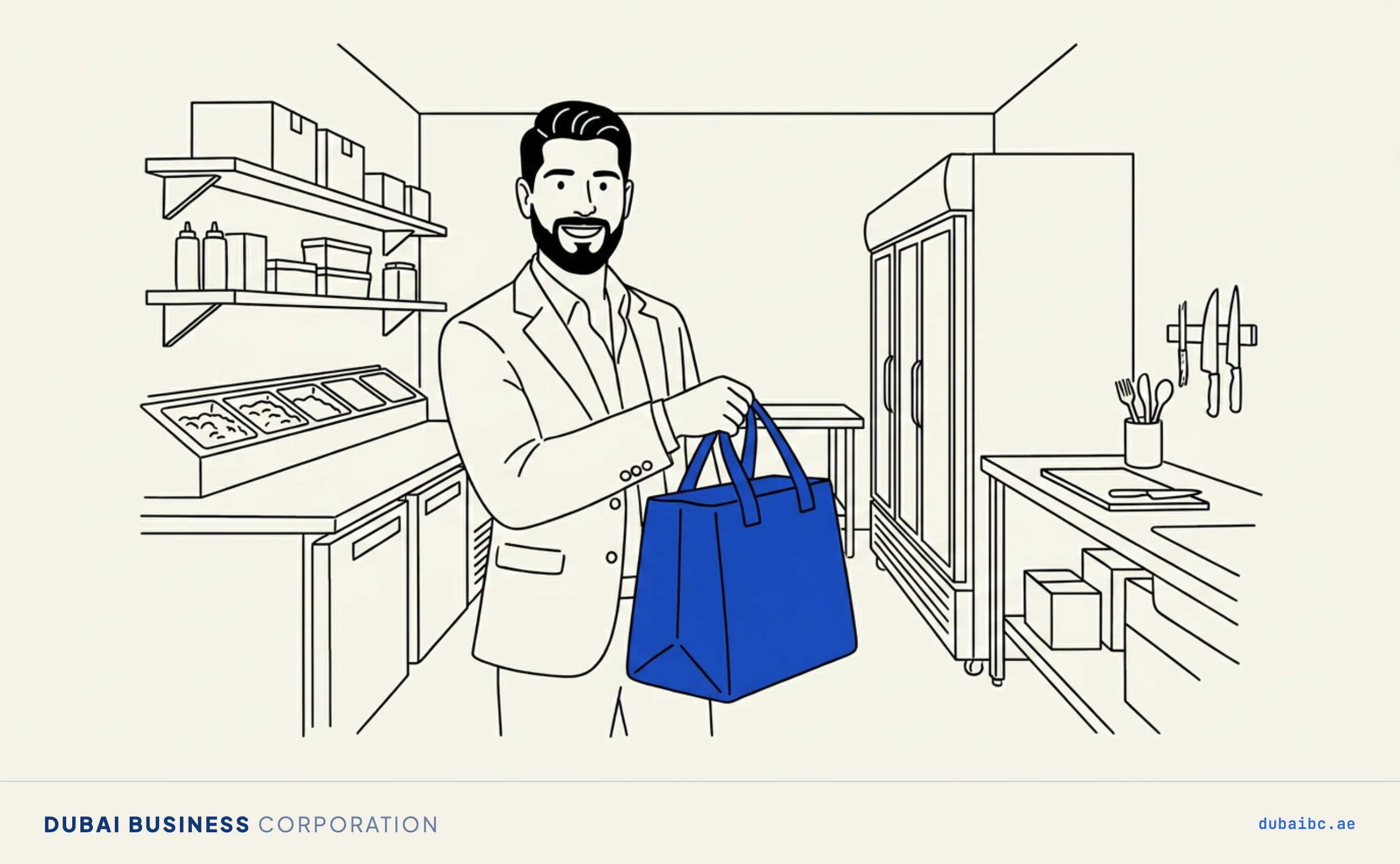
The absence of a dining room removes a real amount of cost and complexity: no front of house fit out, no customer toilets, far less Civil Defence work, and a much smaller footprint.
It does not remove the kitchen requirements, which are where the inspection actually focuses.
Our restaurant guide covers the full seated version if you are weighing the two.
Mainland or Free Zone, and Why This One Is Not a Close Call
Food preparation for the local market is a mainland activity in practice. You are selling to consumers inside Dubai and your premises must sit in an area zoned and approved for food production.
A free zone licence is designed for business conducted within the zone or internationally, which is the wrong shape for a delivery brand serving Dubai neighbourhoods.
A small number of free zones do host food facilities, and the shared kitchen operators themselves sit in various jurisdictions, but for a first cloud kitchen assume mainland. See free zone or mainland for the general comparison.
Two Ways to Get a Kitchen
| Shared kitchen pod | Own fit out | |
|---|---|---|
| Time to open | Weeks | Months |
| Upfront capital | Low | High |
| Monthly cost | High per square foot | Lower per square foot |
| Extraction and utilities | Already built | Your project |
| Approvals | Facility already approved | You run the approvals |
| Control | Limited | Full |
| Best for | Testing a brand | A proven brand at volume |
The pod route exists precisely because kitchen extraction, grease traps, gas and drainage are expensive and slow to approve.
Renting a slot in a facility that already has all of it, and already holds the municipality approvals for the building, is the fastest legal route to a first order.
The trade off is a rate per square foot that would look absurd for an ordinary warehouse.
The Approval Sequence
- Reserve the trade name and take initial approval for the activity. See initial approval.
- Secure the premises and register the tenancy through Ejari.
- Submit the kitchen layout to Dubai Municipality food safety for approval before you build anything.
- Build to the approved layout, including separate preparation areas, hand wash stations and correct storage.
- Pass the food safety inspection and receive the food establishment permit.
- Get the food handlers trained and carded. Every person touching food needs the municipality food handler training.
- Issue the trade licence and open the aggregator accounts.
See the licence, approval and visa fees itemised before you commit to a lease.
Running Several Brands From One Kitchen
This is the model that makes cloud kitchens interesting. One kitchen, one team, one set of fixed costs, and four delivery brands aimed at different occasions.
It is entirely permitted, and it is how most operators reach a workable contribution margin.
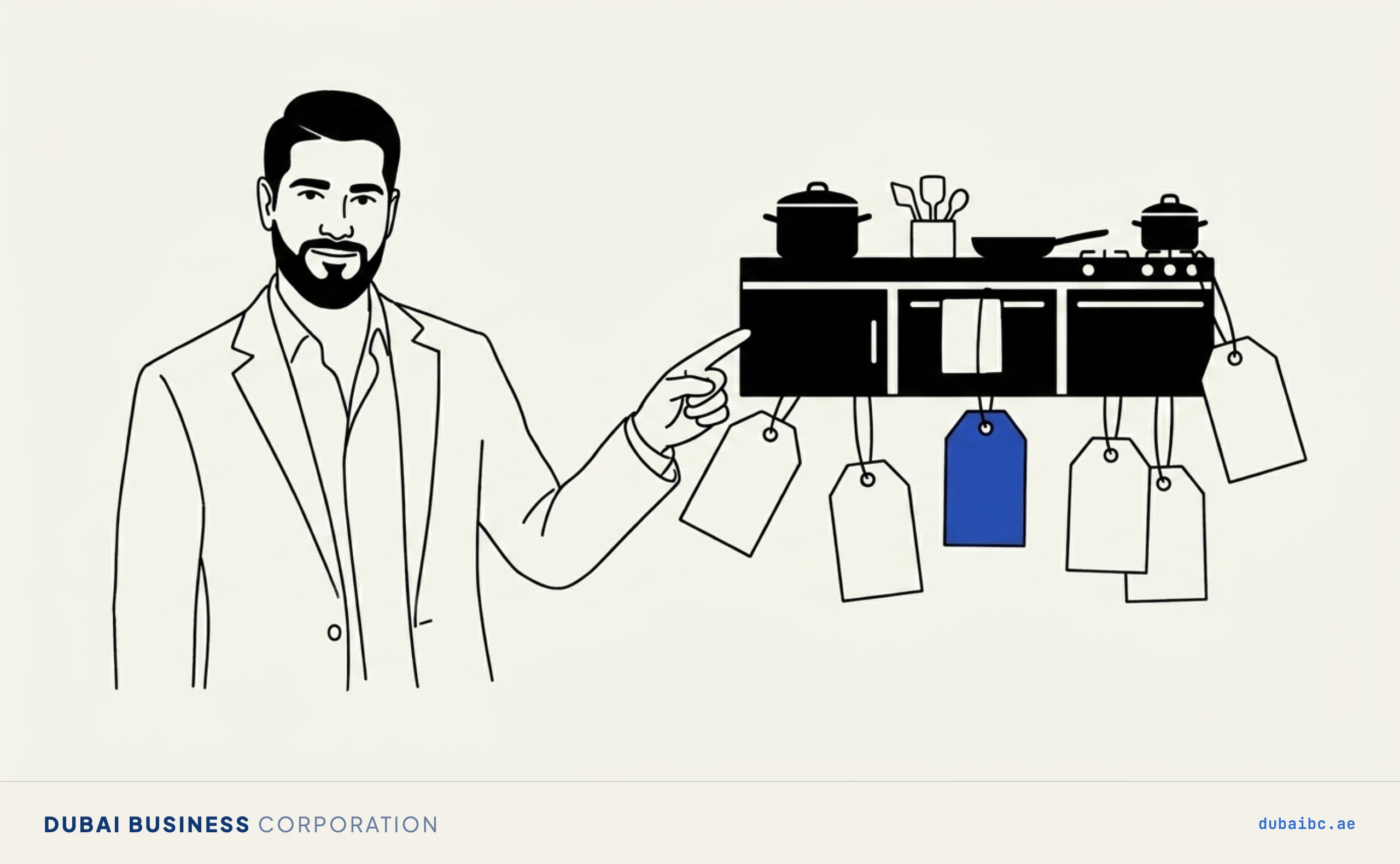
The mechanics matter. Each customer facing brand name should be handled properly as a trade name or a registered mark rather than invented on the aggregator app, and each brand needs its own menu registered with the aggregator.
Our guide to registering a company name explains the trade name rules.
Aggregator Economics, Stated Honestly
Delivery platforms in the UAE typically take a substantial commission on each order, and the exact rate is negotiated per merchant, so no article should quote you one. What matters is the structure: commission comes off the top, before food cost, packaging, labour and rent.
A menu priced for a dine in restaurant will not survive it.

The workable responses are all pricing and menu design rather than negotiation. Delivery specific pricing, bundles that raise the average order value, packaging that keeps the food intact for twenty minutes, and a menu engineered around a small number of high margin items that share ingredients.
Kitchens that fail usually fail on average order value, not on order count.
What It Costs
Split it into four blocks. The company and licence, which is fixed and knowable.
The premises, either a pod rate per month or a fit out project. The equipment, which is the single most variable number and depends entirely on the cuisine.
And working capital for the first several months, because aggregator payouts arrive on a cycle rather than instantly.
Price the fixed side precisely with our cost calculator and treat the rest as your own business plan. Anyone quoting a single all in cloud kitchen figure is quoting one particular kitchen, not yours.
Our hidden costs guide covers the items that usually get left out.
Staffing a Delivery Kitchen
Cooks, kitchen assistants, a packer during peaks, and someone accountable for food safety. Everyone handling food needs the municipality food handler training and card.
Employment runs through the normal route: an establishment card, work permits from MOHRE, residence visas, and wages paid through WPS.
Riders are usually not your problem, and that is deliberate. Most cloud kitchens use the aggregator's delivery fleet rather than employing riders, which avoids vehicle permits, rider permits and fleet insurance entirely.
If you do run your own delivery, see our transport and delivery guide, because that is a separate licensed activity.
Tax and Compliance
Food is subject to 5% VAT in the UAE, so once you pass AED 375,000 in taxable supplies, VAT registration is mandatory.
Aggregators complicate reconciliation because they collect from the customer and remit to you net of commission, so your VAT position is on the gross sale, not the payout.
Get this right in the accounting system from month one, not at the first return. The rules are on the Federal Tax Authority site and our guide to filing a VAT return covers the mechanics.
Common Mistakes
- Signing a lease before layout approval. The unit may not be approvable for food at all.
- Pricing the delivery menu like a restaurant menu. Commission eats the difference.
- Launching six brands at once before one of them is profitable.
- Under-equipping the kitchen and discovering the ticket time cannot meet the platform's standard.
- Treating the aggregator payout as revenue for VAT purposes.
- No brand of your own. If every order comes through one platform, that platform owns your customer.
Choosing Where the Kitchen Sits
Delivery is a radius business. A kitchen serves the neighbourhoods within a workable drive time, and outside that ring your food arrives cold and your ratings fall.
That makes location a demand decision rather than a rent decision, which is the opposite of how most people approach a warehouse lease.
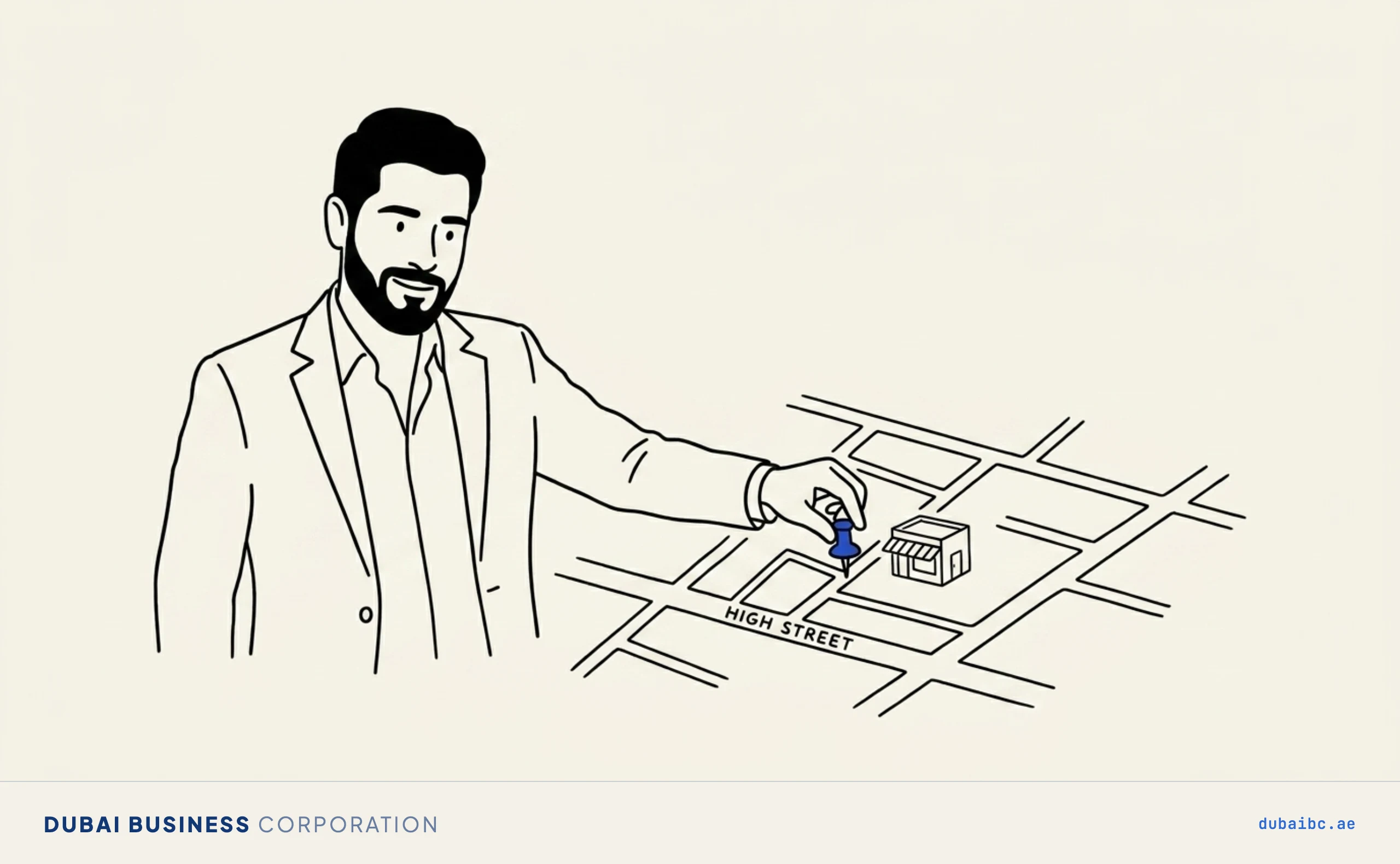
Look at where your target customers actually live and work, then find approved kitchen space inside that ring.
Dubai's established cloud kitchen clusters exist in and around the industrial and mixed use areas precisely because they sit within reach of dense residential communities while paying industrial rather than retail rent.
A cheap unit forty minutes from your customers is not cheap.
Two further practicalities decide the site. Parking and access for riders, because a facility where riders queue in traffic loses you minutes on every order, and power capacity, because commercial kitchen equipment draws far more than a standard warehouse supply and upgrading it is neither quick nor cheap.
The Operating Rhythm of a Delivery Kitchen
Cloud kitchens live and die on ticket time. The platform measures how long you take to accept, prepare and hand over each order, and that measurement feeds your visibility in the app.
A kitchen that runs twenty minutes behind at peak does not simply annoy customers, it gets shown to fewer of them the following week.
Design the menu around that constraint. Items that can be prepped in advance and finished quickly, a small number of shared base ingredients, and packaging that a single person can assemble in under a minute.
Ambitious plating that works beautifully in a restaurant is a liability when every order has a clock on it.
Who This Model Actually Suits
It suits an operator who already knows a cuisine and wants to test it commercially without a million dirham fit out, and it suits an existing restaurant adding delivery capacity in a second catchment.
It suits a first time founder with no food background less well than the low entry cost suggests, because the difficulty moved from capital to operations rather than disappearing.
The route is legal, fast and well trodden. Start in a pod, prove one brand, then decide whether to build your own kitchen with real numbers behind the decision.
One last strategic point that separates the operators who last from the ones who churn. A delivery platform gives you instant distribution and takes your customer relationship in exchange.
Every kitchen that survives its second year builds something the platform does not control: a direct ordering channel, a WhatsApp reorder list, a corporate lunch account, a physical counter for pick up.
Start that in month one, while the platform is still cheap to you in relative terms, rather than in the year when commission is the only thing standing between you and profit.
The businesses that fail rarely fail because of the licence, the municipality or the fit out. They fail because they never got the average order value above the cost of fulfilling it, and they discovered that eight months and one lease commitment too late.
Model that number honestly before you sign anything, and the rest of this is administration.
Frequently asked questions
You need a food related trade licence and Dubai Municipality food safety approval, which is the same regulatory regime a restaurant sits under. The difference is the premises rather than the paperwork: no dining area means no front of house fit out and far less Civil Defence work, but the kitchen itself is inspected to the same food safety standard.
No. Preparing food commercially requires approved premises in an area zoned for it, with a municipality approved kitchen layout, correct storage, and trained food handlers. Home kitchens cannot meet those requirements and cannot be licensed for commercial food production. The lowest cost legal route is renting a slot in an existing approved shared kitchen facility.
There is no fixed limit, and running several delivery brands from one kitchen is a normal and permitted model. Each customer facing brand should be handled properly as a trade name rather than simply invented on the aggregator app, and each needs its own registered menu. The practical constraint is kitchen capacity during peak hours, not regulation.
After food cost, the delivery platform commission is usually the largest line item, and it is deducted before everything else. Rent per square foot in a shared kitchen facility is the next. Because commission rates are negotiated per merchant, build your menu pricing around a conservative assumption and check the real rate before signing a lease.
Usually not. Most cloud kitchens use the aggregator platform's own delivery fleet, which avoids vehicle permits, RTA rider permits and fleet insurance entirely. Running your own delivery in Dubai is a separately licensed transport activity with its own permits, so only take it on if there is a clear commercial reason to control the last mile.
See the number for your setup
The cost calculator runs on Dubai Business Corporation’s real price book. Answer a few questions and get your total, fully itemised, in under a minute.