Emirates ID Explained: What It Is, How to Get It, How to Renew
 Ali Jasim
The Emirates ID is the mandatory national identity card for every UAE resident, issued by ICP, the Federal Authority for Identity, Citizenship, Customs and Port Security. It is applied for alongside your residence visa, requires a biometric appointment, fingerprints, photo and signature, and its validity matches your visa duration, typically 1, 2, 3 or 10 years.
Renewal follows the visa renewal process and must be done before expiry. A lost or damaged card can be replaced for a fee, with a police report generally required if it was lost or stolen.
The Emirates ID is the single most-used document in daily life in the UAE. It confirms who you are for a bank, a hospital, a government service, a parcel delivery, or a SIM card.
Every resident is issued one, and yet the process of getting and renewing it is often bundled invisibly inside the wider visa process, which leaves people unsure what actually happens at the biometric appointment or what to do when the card is about to expire. Here is the whole thing in one place.
What the Emirates ID Actually Is
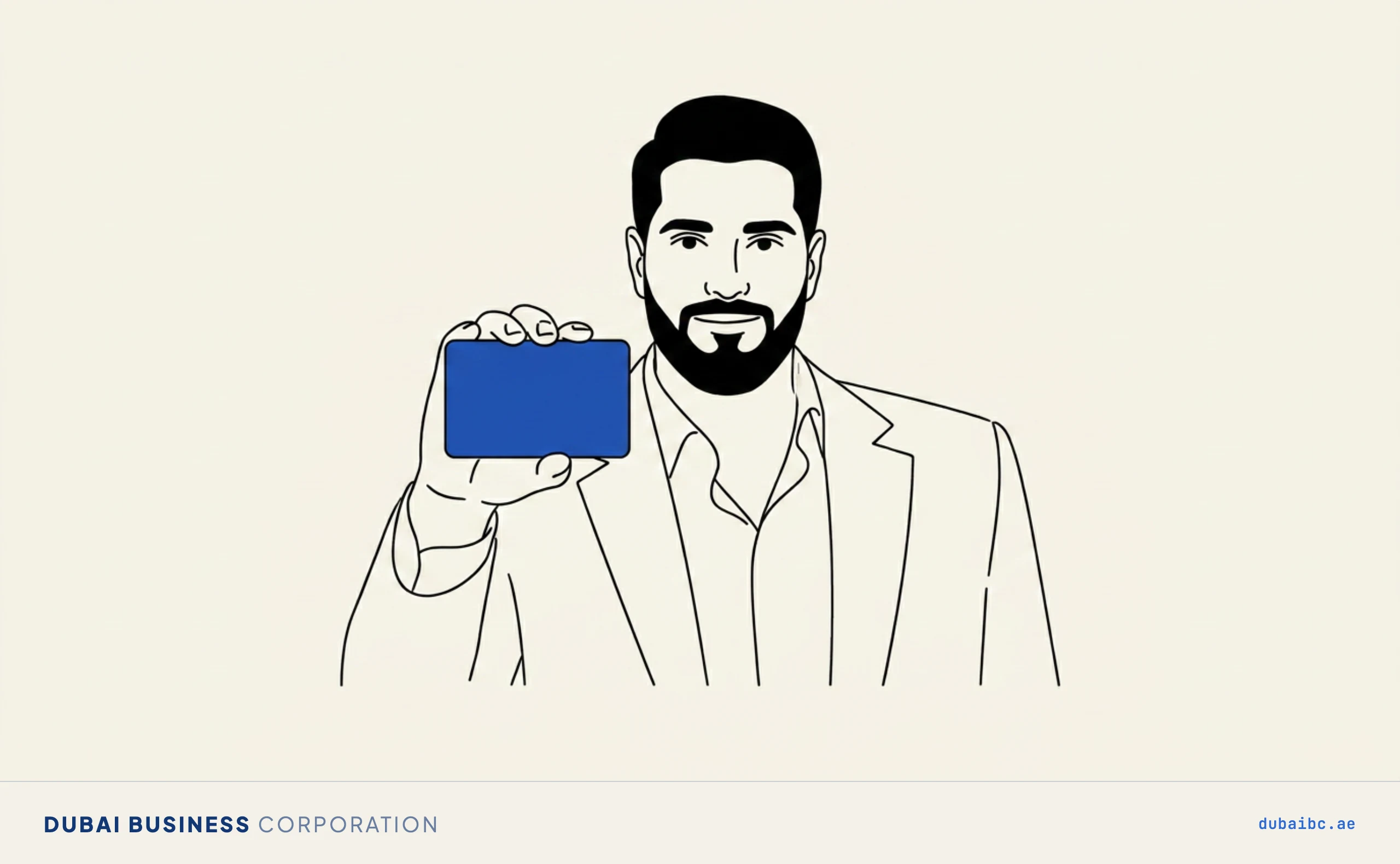
The Emirates ID is a smart card carrying your name, nationality, photo, Emirates ID number, and an embedded chip storing your biometric data.
It functions as your primary proof of identity and residency status inside the UAE, replacing the need to carry a passport for most day-to-day transactions.
It is issued by ICP, the same federal authority that oversees residency and citizenship matters, working alongside GDRFA and MOHRE depending on which visa route you came through.
For UAE nationals the card also carries citizenship-specific data and is issued on its own cycle, separate from any visa process.
For residents, the card is always downstream of a visa; there is no way to obtain an Emirates ID as a resident without first having an active, sponsored residence visa in place, since the card is legally an extension of that residency status rather than a document available on its own.
Who Needs One
Every UAE national and every resident, regardless of visa type, employment, family, investor, freelance, Golden or Green, needs an Emirates ID. Children are included; even infants are issued a card, generally with a shorter validity tied to their own residence visa.
There is no exemption for short-term residents once they hold any form of residence visa; visitors on tourist visas do not need one, but the moment residency starts, the requirement applies.
This applies equally across every visa category covered elsewhere on this site. A shareholder on an investor visa, a household hiring a domestic worker, and a resident sponsoring family all go through the same Emirates ID mechanics, even though the visa itself, and the sponsor behind it, differs in each case.
The card does not distinguish between visa categories in how it looks or functions; it distinguishes only in its validity period, which tracks the underlying visa.
What Information the Card Actually Holds
Beyond the visible details, name, photo, nationality and Emirates ID number, the card embeds a chip storing biometric data and, depending on the generation of card issued, additional digital identity information used for government e-services.
This is why the Emirates ID also functions as a login credential for various UAE government digital platforms, not just a physical identity document.
Losing the physical card is therefore worth treating with the same seriousness as losing a bank card, since it is tied to more than just visual identification.
How the Application Works Alongside Your Visa
You do not apply for the Emirates ID as a separate, disconnected process. It is initiated as part of your residence visa application, usually right after or alongside the medical fitness test.
Once the visa file is registered, an appointment for biometrics is booked at a typing centre or an approved service point. At the appointment, your fingerprints (all ten, typically), a photograph, and a signature are captured.
The card itself is then printed and delivered, commonly through Emirates Post, to the address registered on file.

Validity and How It Matches Your Visa
| Visa type | Typical visa length | Emirates ID validity |
|---|---|---|
| Standard employment | 2 years | Matches, 2 years |
| Investor or partner | 2 to 3 years | Matches the visa term |
| Golden Visa | 10 years | Matches, 10 years |
| Green Visa | 5 years | Matches, 5 years |
| Dependent child | Tied to sponsor visa | Matches the child visa term |
This is why the Emirates ID and residence visa expiry dates are usually identical, or very close.
If your visa is renewed for a different duration than before, for example moving from an employment visa to a Green Visa, expect your Emirates ID validity to change accordingly at the next renewal.
Renewing Your Emirates ID
Renewal runs in step with your residence visa renewal. As your visa approaches expiry, the renewal process, including a new medical test in most cases and updated biometrics if required, triggers a new Emirates ID application.
It is not something you can renew independently of your visa; the two are tied together administratively.
Start the renewal process in the weeks before expiry rather than waiting until the card has lapsed, since using an expired Emirates ID, or being without a valid one, can carry fines and complicate transactions that require it.
We manage the full visa file, including biometrics scheduling and Emirates ID timing, so nothing lapses. Price your visa plan to see the full picture.
What if Your Emirates ID Is Lost, Stolen or Damaged
A lost or stolen card should be reported to the police first; the police report is generally required to process a replacement, partly as a fraud safeguard since the card carries personal biometric data.
A damaged card, one that is cracked, demagnetised or otherwise unusable, can usually be replaced without a police report, just an application and the replacement fee.
In both cases you apply through the ICP smart channels or an approved typing centre, and a new card is issued carrying the same validity as the original.
A replacement card generally does not require new biometrics to be captured, since your fingerprints, photo and signature are already on file from the original application; the replacement process reprints and reissues the card against the existing record.
This makes replacement noticeably faster than the original application, typically a matter of days once the request and fee are processed, rather than the fuller timeline of a first-time Emirates ID.
The Emirates ID Number Versus the Physical Card
It is worth separating the Emirates ID number itself from the physical card. The number is a permanent identifier assigned to you, and it does not change across renewals or replacements; only the physical card and its expiry date change.
This is why the number appears on other documents, insurance policies, bank records, and tenancy contracts, as a stable reference even as the card itself is replaced or renewed over the years.

Using the Emirates ID Day to Day
- Banking. Every UAE bank requires a valid Emirates ID to open or maintain an account.
- Healthcare. Hospitals and clinics use it to confirm identity and insurance eligibility.
- Government services. Most portals, from traffic fines to utility connections, are accessed using the Emirates ID number.
- Mobile and telecom. A SIM card cannot be registered in the UAE without a valid Emirates ID.
- Travel. It is checked at UAE airports alongside the passport for residents.
Because it is checked so constantly, an expired Emirates ID has a way of surfacing at the worst possible moment, a bank transaction that suddenly fails, a SIM top-up that will not process, a rental renewal that stalls.
None of these are permanent problems, but they are avoidable ones, and the fix, an on-time renewal tied to your visa, is entirely within your control if the dates are tracked properly.
Emirates ID for Visit Visa Holders and Long-Term Visitors
People on a visit or tourist visa do not receive an Emirates ID, since it is a residency document, not a general identity card for anyone present in the country.
The moment a visit visa converts to a residence visa, whether through an in-country status change or a fresh entry, the Emirates ID process begins as part of that new residence application, on exactly the same timeline as any other new resident.
This sometimes trips up long-term visitors who assume that simply spending extended time in the UAE on repeated visit visas eventually earns them some form of identity card. It does not.
There is no accumulation or grandfathering of visitor time into resident status; the Emirates ID only becomes available the moment an actual residence visa category is genuinely held, regardless of how many months or years someone has spent in the country on visit status alone.
How the Emirates ID Differs Across Visa Categories
While the card itself looks the same regardless of visa type, its validity period is what changes, and this is worth understanding before you assume a renewal date.
A resident who moves from a standard employment visa to a Green Visa, for example, will see their next Emirates ID issued with a 5-year validity instead of the usual 2 years, simply because the underlying visa term changed.
Anyone comparing options between the Golden Visa and Green Visa should factor in this knock-on effect on how often the card itself needs renewing, since fewer renewals over a decade is a real, if minor, convenience some residents value.
Common Emirates ID Mistakes
- Letting it expire alongside a delayed visa renewal. If the visa renewal is slow, the Emirates ID can lapse with it; track both dates, not just one.
- Missing the biometric appointment. This resets the timeline and can hold up the whole visa file.
- Not updating the delivery address. The card is posted; an outdated address means a lost or delayed card.
- Assuming a police report is not needed for a lost card. It usually is, and skipping this step delays the replacement.
The Emirates ID is simple once you see it as a side effect of your visa status rather than a separate errand.
If you are still deciding which visa route to take before any of this applies to you, our guides on the employment visa and the freelance visa are good starting points, and our guide to overall visa timing shows exactly where the Emirates ID step sits inside the wider process, alongside every other stage from entry permit to final stamping.
Frequently asked questions
Once biometrics are captured, the card is typically printed and delivered within 1 to 2 weeks, though this runs in parallel with the rest of your residence visa processing rather than as a fully separate timeline.
Yes, in almost all cases. The Emirates ID validity is matched to your residence visa duration, so a 2-year visa carries a 2-year Emirates ID and a 10-year Golden Visa carries a 10-year Emirates ID.
File a police report first, since it is generally required to process a replacement given the biometric data the card holds. Then apply for a replacement through ICP or an approved typing centre and pay the replacement fee.
Yes. Every dependent, including infants, is issued an Emirates ID tied to their own residence visa, generally with the same validity period as that visa.
No. Emirates ID renewal is tied to your residence visa renewal and happens as part of that same process, including a new medical test in most cases. They are not renewed independently of each other.
See the number for your setup
The cost calculator runs on Dubai Business Corporation’s real price book. Answer a few questions and get your total, fully itemised, in under a minute.