UAE Holding Company Structure for Asset Protection
 Ali Jasim
A UAE holding company sits above one or more operating businesses, owning their shares rather than running operations itself. This separates personal and group assets from the liabilities of any single trading business, so a claim, debt or lawsuit against one operating entity does not automatically reach the others or the owner personally.
Offshore companies (JAFZA Offshore, RAK ICC) are the most common holding vehicle because they need no office and cannot trade, keeping them clean and low-cost. Asset protection has real limits: it does not shield against fraud, personal guarantees, or a poorly maintained corporate structure.
Founders with more than one business, or with real assets alongside a trading company, eventually ask the same question: what happens if one part goes wrong. A holding company structure is the standard answer, and the UAE offers a clean, low-cost way to build one.
Here is what the structure actually does, what it is built from, and, just as important, what it does not protect against.
What "Asset Protection" Means Practically
Asset protection is not a magic shield; it is a structural choice about where liability can legally reach.
If you run everything, property, IP, an operating business, all in one personal name or one company, a problem in any part of it can expose all of it.
Splitting ownership so that operating risk sits in one entity and valuable assets sit in another means a creditor or claimant against the operating entity generally cannot reach the assets held separately, provided the structure is genuinely maintained as separate.

It helps to picture two founders with an identical business. One runs everything through a single free zone company: office lease, staff contracts, client agreements, and the company car all sit in that one entity, alongside its cash reserves.
The other runs the same business through a free zone operating subsidiary, with an offshore holding company above it that owns the shares and holds the founder's other property and savings-linked assets separately.
If a client dispute or a bad debt hits the operating company, the first founder's entire position is exposed to that single legal risk.
The second founder's exposure is limited to what sits inside the operating company itself.
Why You Separate Ownership From Operations
The logic is simple: operating businesses take on risk every day, contracts, staff, customers, suppliers, and any of those can go wrong. Property, intellectual property and cash reserves do not need to sit inside that risk.
A holding company lets you own the operating business through shares, so the operating entity can fail, be sued, or be sold, without dragging the assets held above it into the same outcome.
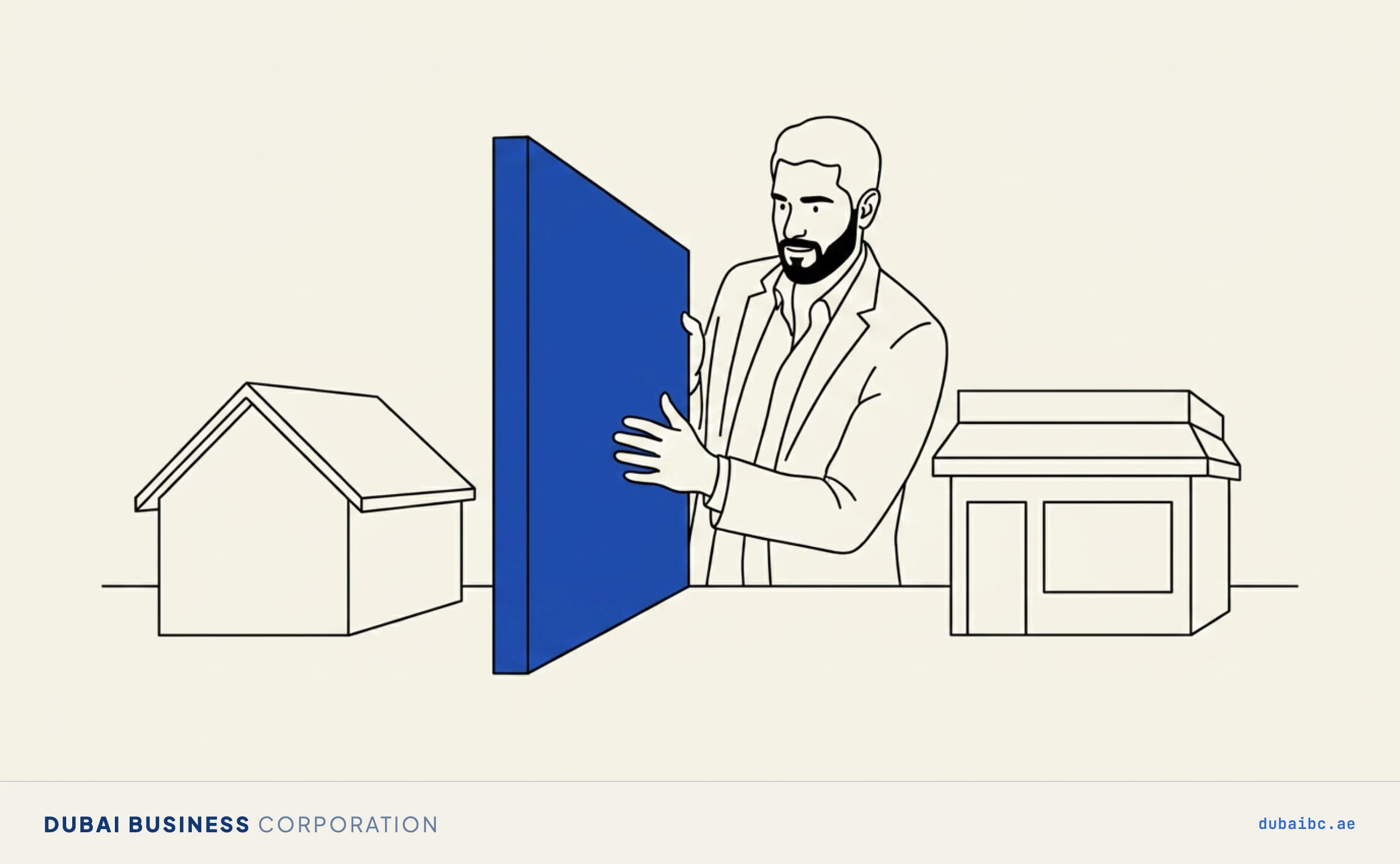
This separation also makes the business itself easier to sell or restructure later. A buyer for the operating company can acquire its shares from the holding company cleanly, without needing to untangle personal property or unrelated assets that were never really part of the business in the first place.
Keeping the layers distinct from day one avoids a messy unwind years later.
Holding Company Structures Available in the UAE
There are three practical ways to build the holding layer. An offshore company (JAFZA Offshore or RAK ICC) is the most common, purpose-built for holding shares, property and IP with no office and no operating licence.
A free zone holding company is also possible, where the free zone entity itself only holds shares in subsidiaries rather than trading, though this is less common since offshore does the same job more cheaply.
A mainland holding structure exists too, mainly used by larger groups where the parent needs a UAE-licensed operating presence of its own.
The choice between these three rarely comes down to legal capability, since all three can technically hold shares, property and IP.
It comes down to cost and fit: a solo founder or family with straightforward holding needs is almost always better served by the low-cost offshore route, while a free zone or mainland holding layer only earns its extra cost when the wider group already has a specific operational reason to sit inside that jurisdiction.
Each of these sits under a different registry with its own filing and disclosure rules, and where the holding company owns Dubai property the ownership also has to be acceptable to the Dubai Land Department.
| Offshore | Free zone holding | Mainland holding | |
|---|---|---|---|
| Typical cost | Lower | Higher, licence and renewals | Highest, office required |
| Office needed | No | Often flexi-desk | Yes |
| Can hold shares/property/IP | Yes, its core purpose | Yes | Yes |
| Best for | Most founders and families | Groups already inside a free zone | Large UAE-based corporate groups |
Shielding Personal Assets From Business Liability
The most common version of this structure is a single founder who owns a UAE offshore holding company, which in turn owns the shares of a free zone or mainland operating company.
If the operating company faces a dispute, a bad debt or insolvency, the claim is generally limited to that entity's own assets, not the founder's personal savings, property, or other business interests held separately through the holding company, provided proper corporate formalities were followed throughout.
Protecting Multiple Business Lines From Each Other
Founders running more than one business often make the mistake of running both under a single company, or under a single personal name. If one line of business runs into legal or financial trouble, it can pull down the other.
A holding structure with separate operating subsidiaries under one parent keeps each business line's liability contained to itself, so a problem in one venture does not automatically threaten an unrelated one.
Succession and Estate Planning
A holding company also simplifies what happens to a business or portfolio on death or when passing assets to the next generation.
Shares in a holding company can be structured with clear succession provisions, sometimes far more cleanly than transferring individual assets or business interests directly.
Families with UAE property, multiple business interests, or members across different countries commonly use a holding structure specifically for this reason.
Confidentiality Considerations
Most UAE offshore jurisdictions do not publish shareholder details on a public register, which gives a genuine level of privacy compared with holding assets or a business in a personal name on public record.
This is a real, legitimate reason founders choose the structure, distinct from and additional to the liability separation itself.
Privacy is not the same as anonymity, and it should not be treated as such. Banks, the registered agent and, where relevant, regulators still hold full KYC records on every shareholder and director.
What the structure limits is public visibility, not regulatory visibility, which is an important distinction to keep in mind when deciding how much weight to put on confidentiality as a reason for the structure.
Price a holding company and an operating company together and see the full picture before you build either one alone.
Choosing Offshore vs Free Zone as the Holding Entity
For most founders, an offshore company is the more efficient holding vehicle: cheaper, no office required, and built specifically for holding rather than trading.
A free zone entity as a pure holding company only tends to make sense if the wider group already operates inside that same free zone and there is a specific reason to keep everything under one authority.
Otherwise, offshore is the default sensible choice for the holding layer, with the operating business built separately as a free zone or mainland company.
A Common Structure: Single Holding, Multiple Subsidiaries
The typical build looks like this: one offshore holding company at the top, owned by the founder or family. Below it, one or more operating companies, free zone or mainland depending on what each business does, each running its own trade licence, staff and visas.
Property and IP sit either directly in the holding company or in their own dedicated holding entities beneath it, kept apart from the trading risk of the operating businesses entirely.

Larger families sometimes go a step further and use a separate holding entity for each major asset class, one for UAE property, one for shares in the operating businesses, one for intellectual property, all owned by a single top-level parent.
This adds administrative overhead, so it usually only makes sense once the group has grown enough that mixing asset classes in one holding entity would create its own complications.
Risks and Limits of Asset Protection
This is the part that gets glossed over and should not be. A holding structure does not protect against personal guarantees; if you personally guaranteed a company loan or lease, that guarantee still reaches you regardless of the structure above it.
It does not protect against fraud, and courts can and do disregard corporate separation, "pierce the corporate veil", when a structure was used to deliberately avoid a legitimate debt or hide assets from a genuine creditor.
It also does not protect against poor bookkeeping that blurs the line between entities in practice.
This is a legal and financial planning tool, not a loophole, and it should be built with proper advice for your specific situation.

Setting One Up: The Steps
- Map the group. List every asset and business line and decide what should sit where.
- Set up the holding entity. Usually a JAFZA Offshore or RAK ICC company.
- Set up or transfer the operating companies as subsidiaries owned by the holding company's shares.
- Keep genuinely separate records for every entity: bank accounts, contracts, board minutes.
- Review the structure periodically as the group grows or circumstances change.
Common Mistakes
- Setting up the paperwork but running it as one pot of money. This undoes the legal separation in practice.
- Forgetting personal guarantees still apply. Structure does not erase obligations you already signed personally.
- Choosing free zone for pure holding when offshore is cheaper. Match the entity type to the job.
- Building the structure after a problem starts. Asset protection planning done under pressure rarely holds up as well as planning done in advance.
Reviewing the Structure as the Business Grows
A holding structure built for a single founder with one operating business rarely stays that shape forever. New business lines get added, property gets bought, a co-founder joins with equity, or the family situation changes.
Each of these is a reason to revisit whether the existing structure still separates risk the way it was originally designed to. A structure reviewed every few years, or whenever a material change happens, stays useful.
One set up once and never revisited tends to accumulate exactly the kind of blurred lines, shared bank accounts, informal loans between entities, that undermine the protection it was built to provide.
The Bottom Line
A UAE holding company, most commonly an offshore entity sitting above one or more free zone or mainland operating companies, is a genuine, well established way to separate risk from assets, plan succession and add a real layer of privacy. It works when built properly and maintained as truly separate entities.
It is not a way to avoid a personal guarantee you already signed, and it is not protection against fraud. Build it early, build it properly, and it does exactly what it is meant to do.
Frequently asked questions
A UAE holding company owns shares in one or more operating businesses rather than running operations itself. It separates ownership from operating risk, so a problem in a trading subsidiary does not automatically reach the owner personally or other parts of the group.
For most founders, yes. Offshore companies such as JAFZA Offshore or RAK ICC are purpose-built for holding shares, property and IP, need no office, and cost less than a free zone or mainland holding entity, which is why they are the default choice for the holding layer.
No. If you personally guaranteed a loan, lease or supplier contract, that obligation still reaches you regardless of any holding structure above the company. Asset protection covers liabilities you did not personally backstop, not ones you did.
No. Courts can disregard corporate separation, sometimes called piercing the corporate veil, when a structure was used to deliberately hide assets from a legitimate creditor or avoid a genuine debt. Asset protection is a legitimate planning tool, not a way to defeat fraud claims.
Yes. A single holding company can own the shares of several operating subsidiaries, whether free zone or mainland, each running its own licence, staff and visas, while liability for each business line stays contained to that entity.
See the number for your setup
The cost calculator runs on Dubai Business Corporation’s real price book. Answer a few questions and get your total, fully itemised, in under a minute.