How to Start an Import Export Business in the UAE
 Ali Jasim
Starting an import-export business in the UAE needs a commercial trade licence with a trading activity matched to your product category, plus Dubai Customs registration for an importer and exporter code, without which no shipment can clear. Certain goods, food, electronics, cosmetics, medical devices, chemicals and agricultural products, need approval from their own regulator (Dubai Municipality, TDRA, MOHAP, or MOCCAE) before import or export.
Free zones near the ports and airport, especially JAFZA and DAFZA, are the most common jurisdiction here.
Import-export is the UAE's founding trade, the country's entire geographic position exists to move goods between continents efficiently, and the licensing framework reflects decades of refinement around exactly this business model. The trade licence itself is simple.
The parts that actually need planning are the customs registration that lets you move goods under your own name, and the product-specific approvals that some categories carry regardless of how well the rest of the setup goes.
The Trading Licence and Activity
An import-export business operates on a commercial trade licence carrying a trading activity matched to the goods involved, either a specific category (electronics, foodstuff, textiles) or a general trading activity if the product range is broad.
This is the same licensing foundation covered in starting a trading company in Dubai, and the same choice between a narrow, named activity and a broader general trading licence applies here, based on how many categories you actually deal in.

Dubai Customs Registration: The Importer and Exporter Code
Holding a trading licence does not by itself let you clear goods through customs.
A separate registration with Dubai Customs (or the customs authority of your specific free zone) issues an importer and exporter code, the identifier tied to your company that customs systems use to process every declaration.
This step happens after the trade licence is issued, and it is a hard prerequisite before your first shipment can move, so build it into your setup timeline as its own milestone rather than assuming it happens automatically alongside licensing.
The code is issued by Dubai Customs against your trade licence and has to be renewed alongside it.
Import duty and the VAT treatment of imports are administered separately by the Federal Tax Authority.

Product Categories That Need Their Own Regulator Approval
Certain goods carry approval requirements independent of your trade licence and customs code, because the relevant regulator cares about the specific product being moved across the border, not the general trading activity around it.
| Category | Approval | Authority |
|---|---|---|
| Food and beverages | Food registration and inspection | Dubai Municipality |
| Cosmetics and personal care | Product registration | Dubai Municipality |
| Electronics and telecom devices | Type approval on relevant items | TDRA |
| Medical devices and pharmaceuticals | Import approval | MOHAP |
| Agricultural products, seeds, livestock | Import permits | MOCCAE |
| Chemicals and hazardous materials | Storage and handling approval | Dubai Civil Defence |
If your goods fall outside these categories, general merchandise, textiles, furniture, building materials, none of the above applies, and the trading licence plus customs code cover you completely.
Certificates of Origin and Shipment Documents
Beyond company-level licensing, individual shipments carry their own paperwork: a certificate of origin confirming the source country of the goods (often required by the destination country or for preferential tariff treatment under trade agreements), commercial invoices, packing lists, and, for regulated goods, the relevant approval certificate attached to that specific shipment.
This is ongoing, per-shipment work rather than a one-time setup cost, and a good freight forwarder or customs broker (see starting a logistics company for how that side of the industry works) typically handles this documentation on your behalf.

Free Zone or Mainland for Import-Export
Free zones with direct logistics infrastructure are the traditional and still most common choice for import-export businesses. JAFZA, next to Jebel Ali Port, suits sea freight-heavy trade, while DAFZA, next to Dubai International Airport, suits businesses moving higher-value, time-sensitive goods by air.
These zones offer customs efficiencies for goods that are being re-exported rather than sold locally, since goods can sit in a bonded zone before final clearance.
Mainland suits a business that is importing goods specifically to sell and distribute within the UAE market on an ongoing basis, since it avoids the distributor step a free zone company would need for sustained local sales.
Compare the full trade-offs in free zone vs mainland based on whether your business is primarily re-export, or local distribution.
Combine your trading activity, jurisdiction and warehouse plan into one clear, itemised number with the cost calculator.
Warehousing and Cash Flow Planning
Import-export businesses typically need to hold stock somewhere between arrival and onward sale or shipment, whether a free zone bonded warehouse or a mainland storage facility. This is a genuine cost bucket that scales with volume and needs planning alongside the licence itself.
Cash flow is also a real consideration in this industry specifically: goods are often paid for on arrival or ordering, while sale proceeds land later, so working capital planning matters as much as the licensing steps covered here.
Step by Step for an Import-Export Setup
- Define your product categories and check which, if any, need a specific regulator's approval.
- Choose jurisdiction: a free zone near ports or the airport for re-export-heavy trade, mainland for ongoing local distribution.
- Reserve your trade name and select trading activities matching your product range.
- Apply for the trade licence, then immediately register with Dubai Customs for your importer/exporter code.
- Start any product-specific regulator approvals in parallel, since these often take longer than the licence.
- Secure warehouse or storage space sized to realistic first-year volume.
- Set up documentation processes for certificates of origin and shipment paperwork, ideally with a customs broker or freight forwarder.
Trade Finance and Letters of Credit
Import-export businesses commonly rely on letters of credit and other trade finance instruments to manage the timing gap between paying an overseas supplier and receiving payment from a buyer, particularly for larger or first-time transactions with a new trading partner.
UAE banks offer these facilities to established trading companies, and having a clean company file, a proper trading track record, and complete shipment documentation makes accessing trade finance considerably smoother as your volumes grow.
This is worth planning for as part of your banking relationship from the start rather than only when a large deal makes it urgent.
Typical Timeline for an Import-Export Setup
A free zone trading licence suited to import-export can typically be issued in three to seven working days. The Dubai Customs importer/exporter code registration follows within one to two weeks of the licence.
Product-specific regulator approvals, where applicable, are the real variable, ranging from a couple of weeks for straightforward categories to a few months for more heavily regulated goods like pharmaceuticals or certain food categories, so start those applications the moment your product list is finalised.
Choosing Freight Partners and Incoterms
An import-export business rarely moves its own goods end to end, so choosing reliable freight forwarders and customs brokers, whether in-house or outsourced, is as important as the licensing itself.
Agreeing clear Incoterms (the standard international trade terms that define who is responsible for shipping cost, insurance and risk at each stage of a shipment's journey) with every supplier and buyer avoids the common and expensive confusion over who pays for what when a shipment is delayed, damaged, or incurs an unexpected customs charge.
New importers and exporters who skip this step often discover the gap only when a dispute over an unpaid freight or duty bill arises mid-shipment.
Building a relationship with one or two dependable freight forwarders, rather than shopping purely on price for every shipment, generally pays off through better handling of the inevitable delays and paperwork issues that come up in international trade, since a forwarder who knows your business well is more responsive when something needs fixing quickly.
Re-Export and Free Zone Bonded Storage
A meaningful share of Dubai's import-export activity is re-export, goods imported into a free zone bonded warehouse, then shipped onward to a third country without ever formally clearing into the UAE mainland market, avoiding UAE import duty on that portion of the business.
This is one of the specific advantages a free zone location like JAFZA offers over a mainland setup for a business genuinely built around regional or global redistribution rather than local UAE sales.
If re-export is a meaningful part of your model, structure the business and choose the free zone with this specifically in mind, since the customs treatment differs materially from goods cleared for local UAE sale.
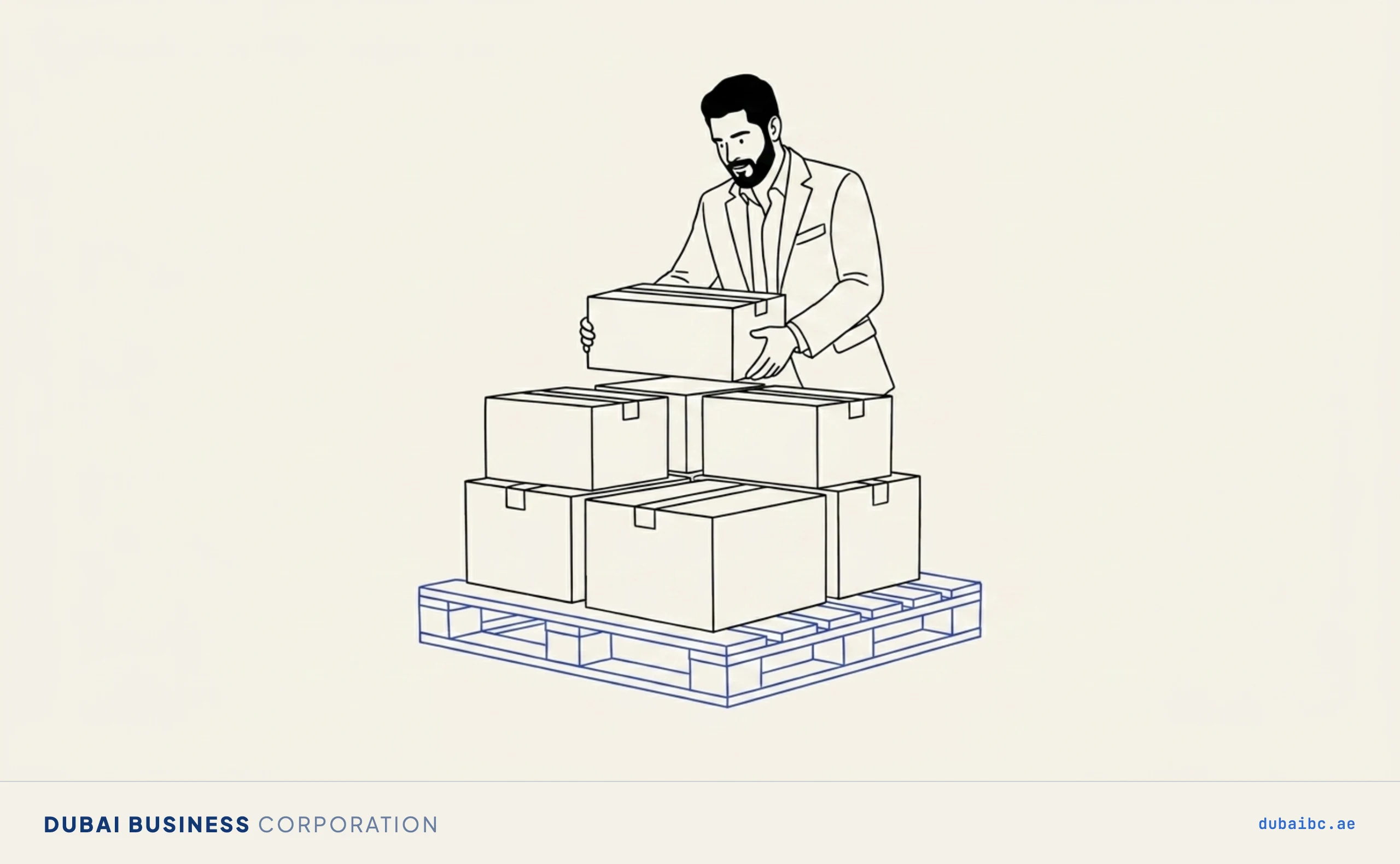
Dubai's position between major manufacturing hubs in Asia and consumer markets across the Middle East, Africa and Europe is exactly what makes this re-export model work at scale, and it is worth understanding whether your business is fundamentally a re-export play or a local-market import business before choosing your jurisdiction and warehouse strategy, since the two models are structured quite differently even though both fall under the same general trading licence framework covered earlier.
A business that expects to do both should plan for the accounting and documentation split between the two flows from the start, since customs and tax treatment differ between goods cleared for local sale and goods held in bond for onward shipment.
Getting this split wrong on paper, even if the physical handling is correct, can create real problems at a customs or tax audit later, so keep the two flows clearly separated in your records from the very first shipment, ideally with a bookkeeper or accountant who already understands the distinction between these two quite different customs treatments right from day one of trading.
Common Mistakes to Avoid
- Assuming the trade licence lets you clear customs. The Dubai Customs code is a separate, mandatory registration.
- Ignoring product-specific approvals until a shipment is already held up at customs.
- Choosing a free zone with no relevant logistics infrastructure for the goods being moved.
- Underestimating working capital needs, given the gap between paying for goods and receiving sale proceeds.
- Leaving shipment documentation to be figured out per shipment rather than setting up a reliable process from the start.
Frequently asked questions
A commercial trade licence carrying a trading activity matched to your product category, plus a separate registration with Dubai Customs to obtain an importer and exporter code, without which no shipment can be legally cleared.
No. General merchandise needs only the trading licence and customs code. Specific categories, food, cosmetics, electronics, medical devices, agricultural products and chemicals, each need approval from their own regulator on top of the standard licensing.
JAFZA, next to Jebel Ali Port, suits sea freight-heavy trade. DAFZA, next to Dubai International Airport, suits time-sensitive or higher-value goods moved by air. The right choice depends on how your goods actually move and whether the business is re-export focused.
Mainland is generally better for a business importing goods specifically to sell and distribute within the UAE on an ongoing basis, since it avoids the distributor step a free zone company would otherwise need for sustained local sales.
It is a document confirming the source country of goods, often required by the destination country or to claim preferential tariff treatment under trade agreements. It is handled per shipment, not once at company setup, usually by a freight forwarder or customs broker.
See the number for your setup
The cost calculator runs on Dubai Business Corporation’s real price book. Answer a few questions and get your total, fully itemised, in under a minute.