How to Open a Medical Clinic in Dubai: The DHA Licence Route
 Ali Jasim
Opening a clinic in Dubai requires two separate licences. The facility is licensed by the Dubai Health Authority through its Sheryan platform, in stages: initial approval, layout approval, construction, inspection, then the operating licence.
Separately, every doctor, nurse and technician must hold their own DHA professional licence, obtained through credential verification and an assessment. The trade licence follows the DHA approval, not the other way round.
Healthcare is the most heavily regulated business covered in these guides, and rightly so.
It is also one where the sequence catches people out badly: founders sign a lease, fit out a beautiful clinic, and then discover that the layout was never approved and the specialist they hired cannot be licensed for the scope they were hired to deliver.
Understanding the order of operations is worth more here than anywhere else.
Which Regulator You Fall Under
Dubai has more than one healthcare regulator, and this is the first decision. A clinic in mainland Dubai is licensed by the Dubai Health Authority.
A facility inside Dubai Healthcare City falls under that free zone's own health regulator instead. Facilities in other emirates fall under the federal Ministry of Health and Prevention or the relevant emirate authority.
The regimes are comparable in rigour but not identical in process, fees or timelines, and a licence from one does not transfer to another. Decide where the clinic will sit before you begin, because the whole application path changes with the answer.
For most first clinics serving the general public across Dubai, the mainland DHA route is the default. It gives the widest patient catchment and the most straightforward relationship with insurers.
Facility Licence and Professional Licence
These are two different things and both are mandatory. The facility licence permits a specific premises to operate a specific category of health facility with a defined scope of services.
The professional licence permits a named individual to practise a named specialty in Dubai.

A licensed doctor in an unlicensed facility cannot practise. A licensed facility with unlicensed staff cannot operate.
Both licences carry the scope limitation, so a clinic licensed as a general practice cannot simply add a dermatology laser because it bought one, and a general practitioner cannot perform procedures reserved to a specialist.
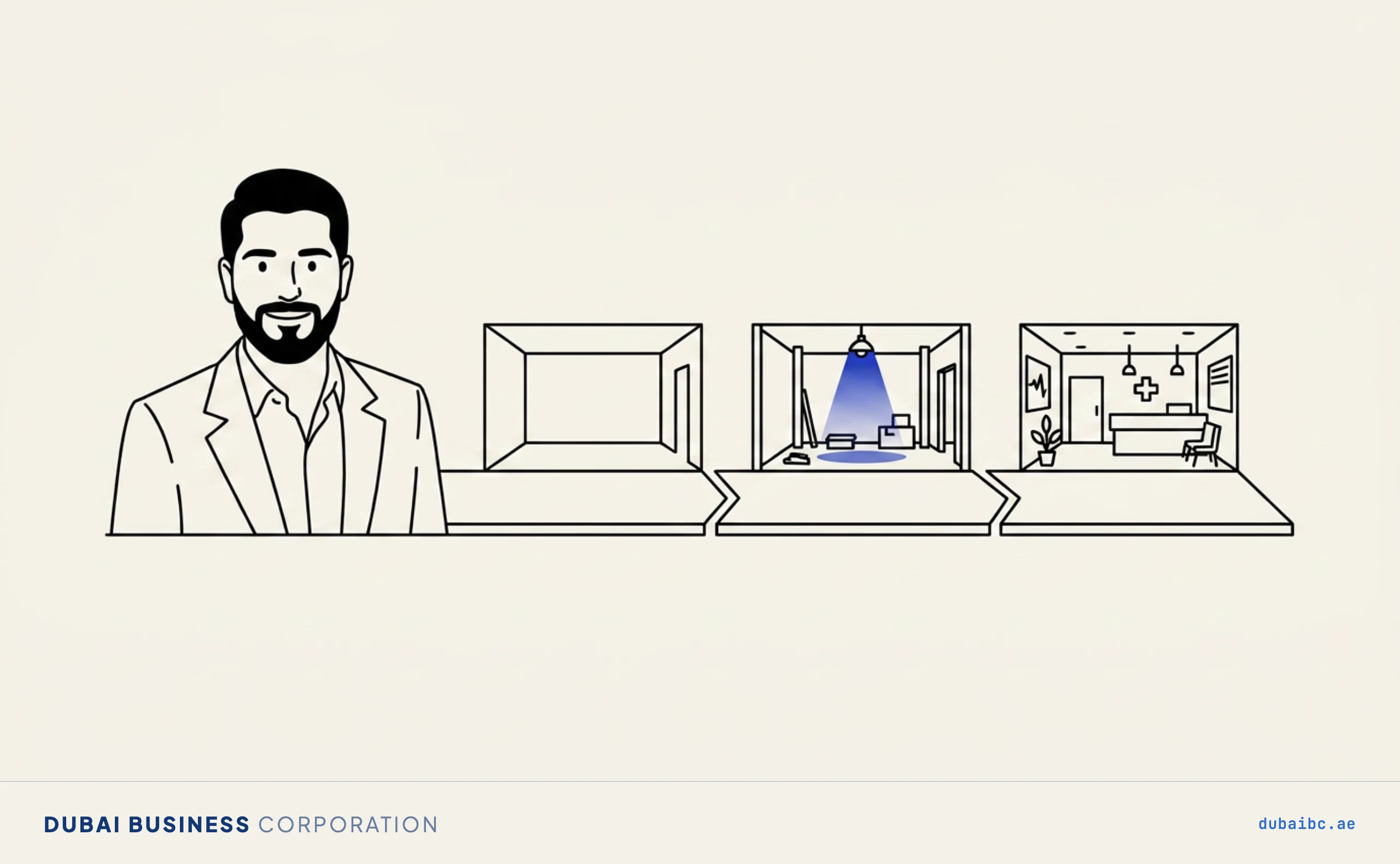
The Facility Stages, in Order
- Initial approval. Submit the concept, category of facility, proposed scope and the owner details to DHA.
- Site and layout approval. Submit the premises drawings against DHA's design standards, including room sizes, flow, infection control, waste handling and accessibility.
- Construction and fit out strictly to the approved drawings, with the other approvals in parallel including Civil Defence.
- Equipment and staffing. Register the equipment and licence the practitioners for the approved scope.
- Inspection. DHA inspects the completed facility against the approved layout and the operating requirements.
- Operating licence issued, after which the trade licence and the rest of the corporate paperwork are completed.
The sequence is the point. Almost every expensive failure in this sector is a founder who inverted steps two and three.
Approved drawings first, construction second, always.
Licensing the Practitioners
Every clinician follows their own path: primary source verification of their qualifications and experience through the recognised verification service, an eligibility assessment, in many cases an examination or interview appropriate to their specialty, and then the licence itself. Only after that can they be employed and sponsored by the clinic.
Verification is the long pole. It relies on universities, hospitals and licensing bodies in other countries responding, and those responses are outside anyone's control.
Start it the moment a hire is agreed rather than when the fit out is finished, and never sign an employment contract that assumes a licence date you cannot guarantee.
Document attestation feeds into this too, since degrees and experience certificates generally need to be properly attested. Our guide to attesting documents for the UAE explains that chain.
Get the licence, establishment card and staff visa fees itemised while you work through the DHA approvals.
Premises: What the Standards Actually Demand
Health facility design standards are detailed and specific. Expect requirements covering minimum room dimensions, separation of clean and dirty flows, hand hygiene provision, treatment room ventilation, waiting area capacity, accessible toilets, clinical waste storage, and dedicated space for sterilisation where the scope requires it.
This is why an ordinary office or retail unit is rarely convertible without significant work, and why the landlord conversation matters early. Drainage, power and ventilation modifications are frequently needed, and not every building will permit them.
Insurance, and Why It Decides Your Revenue
Health insurance is mandatory for residents in Dubai, which means most patients arrive holding a policy and expect to use it.
A clinic that is not empanelled with the major insurers is asking patients to pay cash in a market where they do not have to, and that constraint shapes the entire commercial plan.

Empanelment is a separate process with each insurer or third party administrator, it takes time, and it typically requires the facility licence to already be in place.
Build a cash flow that assumes several months of operating before the main insurer contracts are live, because that gap has closed more new clinics than any clinical issue.
What It Costs
| Cost block | Notes | |
|---|---|---|
| DHA approvals | Per stage and per licence | Set by DHA |
| Practitioner licences | Per clinician | Plus verification fees |
| Premises and fit out | Largest single item | Driven by the standards |
| Medical equipment | Highly variable | By specialty |
| Company and visas | Fixed and knowable | See the calculator |
| Working capital | 6 to 12 months | Insurance empanelment lag |
The corporate side, meaning the trade licence, establishment card and residence visas, is precise and can be quoted exactly through our cost calculator. The DHA fees are set by the authority and published by them.
The fit out and the equipment are the large variable numbers and are entirely a function of the specialty and the standard you are building to.
Staffing Beyond the Clinicians
A clinic needs reception, insurance coordination, nursing support and someone accountable for quality and compliance.
Insurance coordination is a genuinely specialist role in this market: approvals, claims, rejections and resubmissions are a daily operation, and a weak coordinator costs a clinic more than a weak marketing plan.
All staff are employed and sponsored by the company through the usual route: establishment card, work permits from MOHRE, residence visas and wages through WPS.
Ongoing Compliance
The licence is the beginning. Clinics operate under continuing obligations: patient record keeping and confidentiality, clinical waste disposal through approved contractors, equipment calibration and maintenance records, controlled drug handling where applicable, incident reporting, and continuing professional development for licensed staff.
Inspections are routine. The clinics that pass them easily are the ones where the documentation is a daily habit rather than a pre inspection scramble, and the difference is visible immediately to anyone who has done this before.
Tax and Corporate Matters
Healthcare has specific VAT treatment in the UAE, with certain qualifying healthcare services zero rated while other supplies, notably cosmetic and elective treatments, are standard rated.
Getting the split right in your billing system from the start matters, because an aesthetics heavy clinic and a general practice have genuinely different VAT positions.
See the Federal Tax Authority and our VAT registration guide.
Corporate tax applies normally at 9% above AED 375,000 of profit, as explained in our corporate tax guide.
Choosing the Specialty and the Location Together
A clinic is a catchment business. Patients choose convenience for routine care and travel further only for genuine specialism, so the decision about what you offer and where you offer it has to be made as one decision rather than two.
A general practice or a dental clinic needs to sit inside a dense residential community with parking, because it competes on proximity. A specialist practice with a known consultant can afford to sit in a medical district and draw patients across the city.

Look honestly at what already exists within a few kilometres. Dubai has areas thick with general clinics and areas with genuine gaps, and the gaps are not always where rent is cheapest.
Population density, the age profile of the community, whether families or single professionals live there, and the insurance mix of those residents all change which specialty is viable on that street.
The other half of the decision is the practitioner. A clinic built around a consultant with an existing patient following starts from a very different position than one hoping to attract walk ins.
If that is your model, secure the clinician before the lease, because the whole business case rests on them being licensable and staying.
Building the Patient Base
New clinics fill slowly, and this is the reality most financial models understate. Insurance empanelment brings volume once it lands, but before that you are dependent on local awareness, referrals and reputation.
Expect the first months to be quiet, and staff accordingly rather than hiring a full roster for a schedule that is not yet there.
What works in this market is unglamorous and local: an accurate and complete listing so people nearby find you, genuine reviews from real patients, relationships with neighbouring pharmacies and GPs who refer, and corporate arrangements with employers in the same district.
Advertising of healthcare services is regulated, so claims about outcomes and treatments must stay within what the authority permits, and that is another reason to lead with visibility rather than promotion.
Retention is where the economics actually improve. A patient who returns and brings their family is worth many times the cost of acquiring them, which makes appointment reliability, waiting times and the front desk experience commercially significant rather than merely nice.
Common Mistakes
- Fitting out before layout approval. The most expensive error in this sector.
- Hiring clinicians before starting their verification.
- Assuming a general licence covers specialist procedures.
- Budgeting no working capital for the insurance empanelment gap.
- Choosing a unit the building will not let you modify.
- Treating compliance documentation as an inspection task rather than a daily one.
Is it a good business?
Dubai has a large, insured, growing population and a government that treats healthcare as strategic infrastructure. Well run clinics with a clear specialty and proper insurance relationships do well.
The barriers to entry are high and that is a feature, because it keeps the market professional.
What it demands is patience and sequencing. Allow considerably longer than a normal business setup, engage people who have taken a facility through DHA before, and do not let a lease deadline push you into building before the drawings are approved.
Frequently asked questions
Two. A facility licence from the Dubai Health Authority for the premises and its defined scope of services, and a separate DHA professional licence for every doctor, nurse and technician who will practise there. The commercial trade licence follows once DHA approval is in place. A licensed clinician cannot practise in an unlicensed facility, and the reverse is equally true.
Considerably longer than an ordinary business setup, because it runs in stages: initial approval, layout approval, construction to the approved drawings, equipment and staffing, then inspection before the operating licence. The variable that most often extends the timeline is credential verification for the practitioners, which depends on institutions abroad responding, so start that as early as possible.
Only after the layout has been approved. Submitting drawings to DHA and building strictly to what is approved is the correct order. Constructing first and seeking approval afterwards is the most expensive mistake in this sector, because a layout that does not meet the health facility design standards has to be rebuilt at your cost.
Yes. Dubai Healthcare City is a free zone with its own healthcare regulator, its own process, fees and standards, and a licence from one regulator does not transfer to the other. Both are rigorous. Choose deliberately at the start based on where your patients are, how you want to contract with insurers, and the facility type you intend to operate.
Practically, yes. Health insurance is mandatory for Dubai residents, so most patients arrive expecting to use a policy. Empanelment with each insurer or administrator is a separate process that generally requires your facility licence to be in place first, and it takes months. Budget working capital for the period between opening and the main insurer contracts going live.
See the number for your setup
The cost calculator runs on Dubai Business Corporation’s real price book. Answer a few questions and get your total, fully itemised, in under a minute.