Labour Accommodation and Bed Space in Dubai: What Is Legal and What Is Not
 Ali Jasim
Renting out bed spaces or partitioned rooms in ordinary residential apartments and villas is illegal in Dubai, and the penalties fall on the landlord, the sub-lessor and often the occupants. What is legal is purpose built or approved labour accommodation in designated areas, operated under the correct licence and built to Dubai Municipality standards.
If you want to be in this business, that is the route, and there is no compliant shortcut through the residential market.
This subject is worth handling directly, because a great deal of what is written about it online is either vague or quietly encouraging something unlawful. Housing Dubai's workforce is a genuine, needed, licensable business.
Subdividing an apartment into bed spaces is not a smaller version of that business, it is a different thing that the emirate actively enforces against. This guide covers both, and it does not offer a workaround for the second, because there is not one.
What Is Actually Illegal, Plainly
Dubai regulates how residential property may be used, and the rules are specific. Erecting partitions inside an apartment or villa to create additional rooms is prohibited without approval, and approval is not given for the purpose of subdividing a home into rentable cubicles.
Exceeding the permitted occupancy of a unit is a violation. Subletting parts of a unit to unrelated individuals as bed spaces, and advertising those bed spaces, is unlawful.
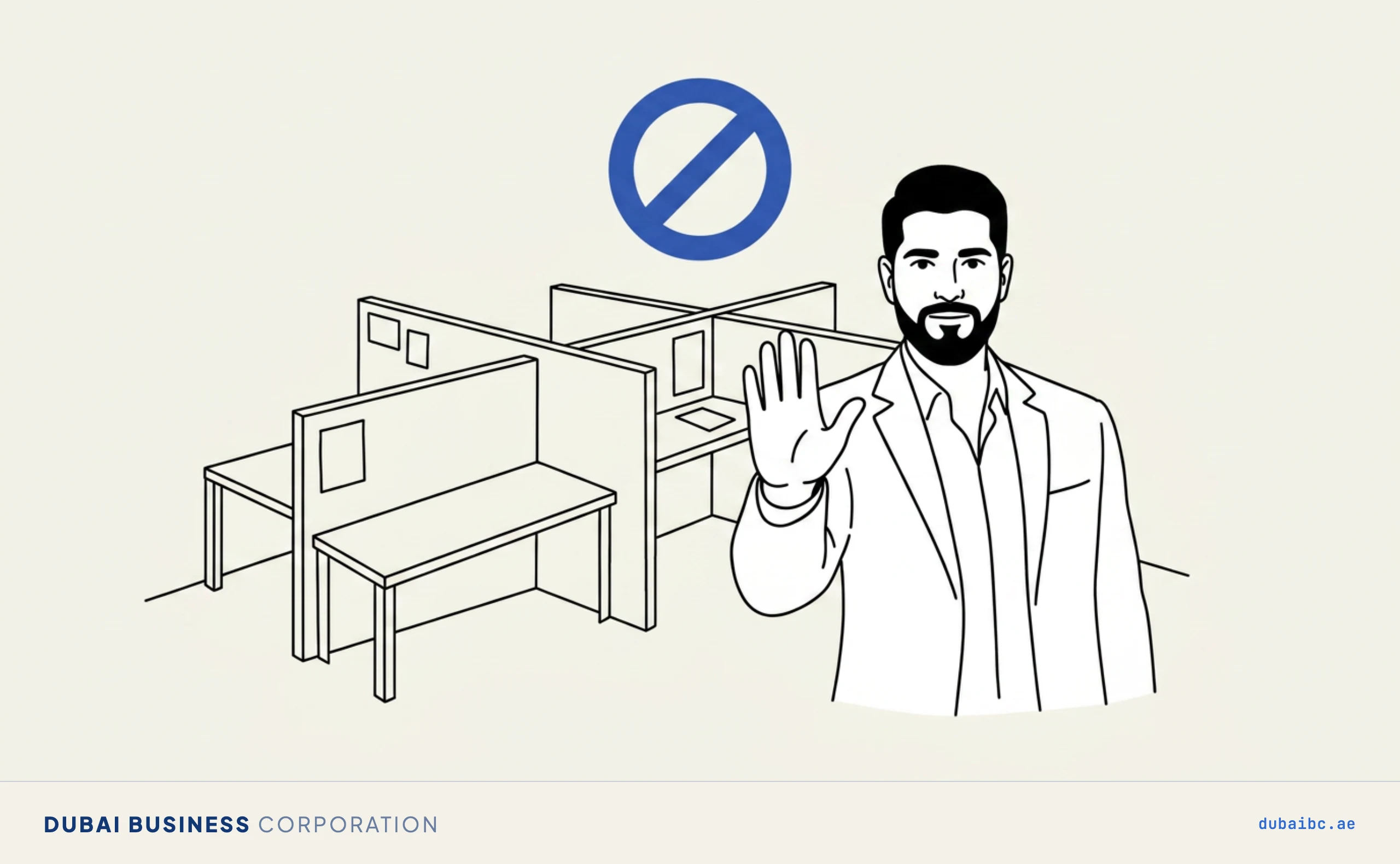
The consequences are practical rather than theoretical. Authorities carry out inspections, particularly following complaints from neighbours or building management.
Penalties include fines, orders to remove partitions at your cost, disconnection of utilities, and eviction of the occupants.
The landlord who permitted it, the tenant who sublet and the agent who advertised it can all be exposed, and for residents the disruption can extend to their housing and their standing.
There is also a safety reason behind the rule that deserves stating. Partitioned units defeat the fire safety design of a building: escape routes are blocked, smoke detectors end up sealed inside cubicles, and occupancy far exceeds what the electrical supply and exits were designed for.
Fatal fires in overcrowded partitioned accommodation are the reason these rules exist and are enforced.
Why the Demand Exists
Dubai has a very large workforce whose earnings do not support a conventional apartment tenancy, and much of it is employed by companies obliged to house staff. That demand is real and permanent, and the emirate has never pretended otherwise.
What it has done is channel the demand into regulated accommodation, in appropriate locations, built to standards, instead of into partitioned villas in residential communities.
Understanding that distinction is the whole business case. The market is not being suppressed.
It is being directed to where it can be operated safely and supervised.
What Licensed Labour Accommodation Looks Like
Purpose built worker accommodation sits in designated industrial and labour housing areas rather than in residential communities, and it is developed and operated to Dubai Municipality requirements. Those requirements cover the things that make shared housing safe and liveable at scale.
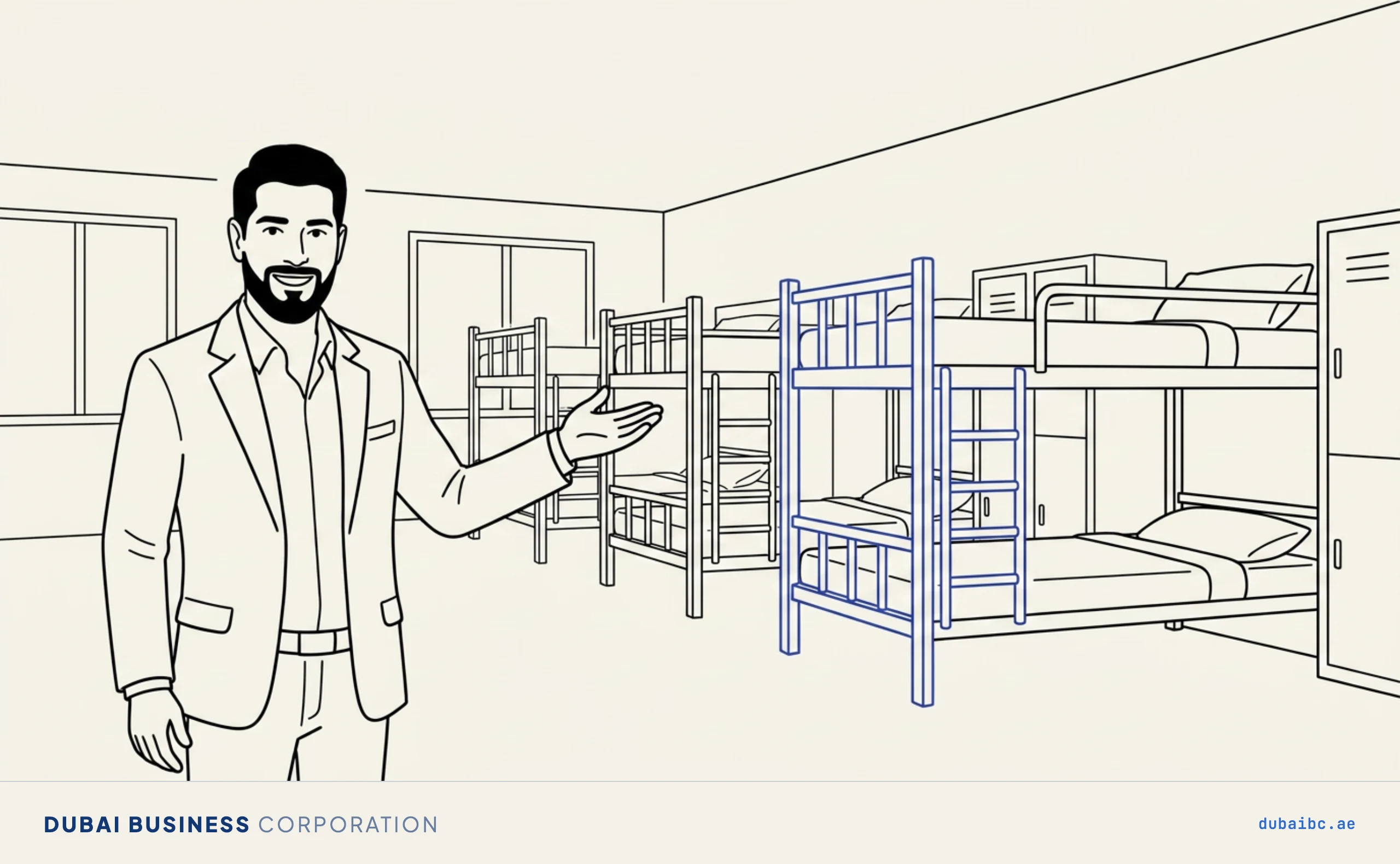
- Space per occupant, with a minimum floor area and limits on how many people share a room.
- Sanitary provision, with defined ratios of toilets and showers to residents.
- Kitchen and dining facilities, properly built and ventilated rather than improvised.
- Fire safety, including Civil Defence approval, alarms, escape routes and equipment.
- Ventilation and cooling, which in this climate is a health requirement rather than a comfort one.
- Waste management, cleaning and pest control as ongoing operational obligations.
- Health and welfare provision appropriate to the number of residents.
Facilities are inspected, and standards are maintained after opening rather than only at approval. Well run accommodation companies treat this as a facilities management operation with a permanent compliance function, because that is exactly what it is.
The Licence and the Approvals
Operating labour accommodation commercially requires a trade licence with the appropriate activity, permits from Dubai Municipality for the facility itself, and Civil Defence approval.
The land or building must be in a zone where this use is permitted, which is the first thing to establish and the one that eliminates most speculative ideas immediately.
Because the specific requirements, classifications and standards are set by the authority and are updated, confirm them directly with Dubai Municipality or through a consultant who has taken a facility through the process recently. This is not an area to plan from a summary.
Get the licence, establishment card and staff visa costs itemised from the real fee schedule.
The Employer's Obligation
If you employ workers, where they live is partly your responsibility. The Ministry of Human Resources and Emiratisation sets expectations on employer provided accommodation, and companies housing staff in unsuitable or unlawful premises face consequences that reach the company itself rather than only the landlord.

For any business with a labour force, whether in delivery, maintenance, construction or manpower supply, this needs to be a real line in the cost model.
The lawful options are more expensive than the informal ones, and pricing a contract on the informal figure is how companies end up with a compliance problem they cannot afford to fix.
Where Co-Living Fits
There is a legitimate and growing middle market: professionally operated shared and co-living accommodation for young professionals, run by licensed operators in buildings where that use is permitted, with proper contracts and management. This is not bed space letting.
It is a licensed hospitality style operation in an approved building.
The distinction turns on the same points as everything else in this guide: is the building permitted for that use, is the operator licensed for that activity, and does the physical arrangement comply with the fire, occupancy and safety rules. If those three answers are yes, it is a business.
If any is no, it is a violation regardless of how it is marketed.
The Economics of Doing It Properly
| Partitioned residential | Licensed accommodation | |
|---|---|---|
| Legal status | Prohibited | Permitted |
| Capital needed | Low | High |
| Revenue per bed | Higher | Lower |
| Risk | Fines, eviction, liability | Ordinary business risk |
| Client base | Individuals | Employers on contract |
| Scalability | None | Real |
The table explains why the informal version persists and why it is a trap. It looks better per bed until the inspection arrives, and it cannot scale, because every additional unit multiplies the exposure.
The licensed version needs capital and produces contracts with employers who want hundreds of beds on stable terms, which is a business you can finance, insure and eventually sell.

Running the Facility
Once open, this is a facilities and people operation: cleaning, maintenance, security, catering in some facilities, transport coordination for residents, and management of the inevitable issues that arise when large numbers of people live together. Staff are employed and sponsored normally, with wages through WPS.
Occupancy contracts are usually with employers rather than individuals, which is commercially attractive because it means fewer, larger, longer relationships.
It also means the standard of the facility is inspected by your corporate clients as well as by the authorities, and reputation in this sector travels quickly among the companies that need beds.
What Tenants and Workers Should Know
If you are the person renting a bed space rather than the person letting it, the position is worth understanding clearly. You have very little protection.
Your occupancy is not a registered tenancy, so the rental law that protects tenants does not help you, and if the unit is inspected you can be required to leave at short notice with no recourse for the money you have paid.
It also affects paperwork you may need. A registered tenancy through Ejari is what allows you to connect utilities in your own name, sponsor family members and satisfy various official requirements.
An informal bed space produces none of that, which is why people in this situation often find themselves blocked at a counter for reasons they did not expect.
If your employer houses you, the accommodation should meet the standards described above. Where it does not, the mechanism is a complaint to the labour authority rather than a private arrangement, and MOHRE enquiry channels exist precisely for that.
Location, Land and the First Question to Ask
Every serious accommodation project starts with zoning. Dubai designates where this use is permitted, and those areas are industrial and labour housing zones rather than residential communities.
If a plot or building is not in a permitted area for this use, the project stops there regardless of how attractive the arithmetic looks.
After zoning comes access. Residents need transport to work sites, so proximity to the industrial areas and to transport routes materially affects whether employers will contract with you.
A remote facility with a low land cost can be commercially unviable simply because the daily bus journey is too long for the companies you are selling to.
Then comes utilities and capacity. Housing large numbers of people requires water, power, drainage and waste handling at industrial scale, and confirming that the infrastructure exists and can be connected is part of due diligence rather than something to establish after purchase.
Common Mistakes
- Assuming a residential building can be converted because the numbers look good.
- Buying land or a building before confirming the zoning permits this use.
- Designing to a cost target rather than to the municipality standards.
- Housing your own workers informally to save money, and exposing the company.
- Treating compliance as a one off approval rather than an ongoing operation.
- Marketing bed spaces publicly, which is both unlawful and self reporting.
The Honest Bottom Line
If the plan was to rent a villa and let out bed spaces, this guide is telling you plainly that it is not a business you can build in Dubai.
It is prohibited, it is enforced, and it is dangerous in a way that has cost lives in overcrowded partitioned housing.
If the plan is to develop or operate proper accommodation in a designated area, it is a substantial and legitimate business with permanent demand and corporate customers. It needs capital, the right land or building, and a genuine commitment to standards.
Start with the zoning question and the municipality requirements, because everything else depends on the answer.
Frequently asked questions
No. Subletting bed spaces or partitioned rooms in ordinary residential apartments and villas is prohibited in Dubai, along with erecting partitions and exceeding permitted occupancy. Enforcement includes fines, orders to remove partitions, disconnection of utilities and eviction, and it can affect the landlord, the person subletting and the occupants. Advertising bed spaces is also unlawful.
Purpose built or approved labour accommodation in designated areas, operated under the correct licence and built to Dubai Municipality standards. Those standards cover minimum space per occupant, sanitary ratios, proper kitchens, fire safety with Civil Defence approval, ventilation, waste management and welfare provision. Facilities are inspected on an ongoing basis, not only at approval.
Because they defeat the fire safety design of the building. Partitions block escape routes, seal detectors inside cubicles and push occupancy far beyond what the exits and electrical supply were built for. Fires in overcrowded partitioned accommodation have caused deaths, which is why enforcement is active and penalties are substantial rather than nominal.
Partly, yes. The Ministry of Human Resources and Emiratisation sets expectations for employer provided accommodation, and companies housing staff in unlawful or unsuitable premises face consequences at company level rather than only the landlord. For any labour intensive business, lawful accommodation should be a real line in the cost model rather than an informal arrangement.
Professionally operated co-living can be lawful where the building permits that use, the operator holds the correct licence, and the physical arrangement complies with fire, occupancy and safety rules. That is very different from subdividing a residential flat into bed spaces. The test is always zoning, licensing and compliance, not how the accommodation is described in the marketing.
See the number for your setup
The cost calculator runs on Dubai Business Corporation’s real price book. Answer a few questions and get your total, fully itemised, in under a minute.