Business Setup in the UAE: The National Guide
 Ali Jasim
Setting up in the UAE means choosing among three jurisdiction types and seven emirates. A mainland licence lets you trade freely inside its emirate.
A free zone licence gives 100% foreign ownership and customs benefits but limits direct mainland trade. An offshore company holds assets and contracts internationally but cannot operate locally or sponsor visas.
The right choice follows your customers, not the marketing.
The UAE is a federation of seven emirates, each with its own economic department, plus more than forty free zones with their own registries and rules, plus a federal layer covering tax, immigration and labour.
It sounds complicated and it is actually rather logical once you see the structure.
This guide lays out the whole national picture so you can choose deliberately instead of taking the first package you are offered.
The Three Jurisdiction Types
| Mainland | Free zone | Offshore | |
|---|---|---|---|
| Trade locally | Yes, in its emirate | Restricted | No |
| Foreign ownership | Usually 100% | 100% | 100% |
| Residence visas | Yes | Yes, by allocation | No |
| Physical office | Required | Flexi desk often enough | None |
| Government contracts | Yes | Limited | No |
| Typical use | Local customers | International and zone trade | Holding assets |
That table answers most first questions. If you are selling to consumers or businesses inside the UAE from physical premises, you want mainland.
If you are trading internationally, consulting for overseas clients, or operating within a zone, free zone is usually right and cheaper. If you are holding shares, property or assets and not operating here at all, offshore is the vehicle.

Our deeper comparisons are in free zone or mainland, offshore versus free zone and whether a free zone company can trade on the mainland.
The Seven Emirates, Honestly Characterised
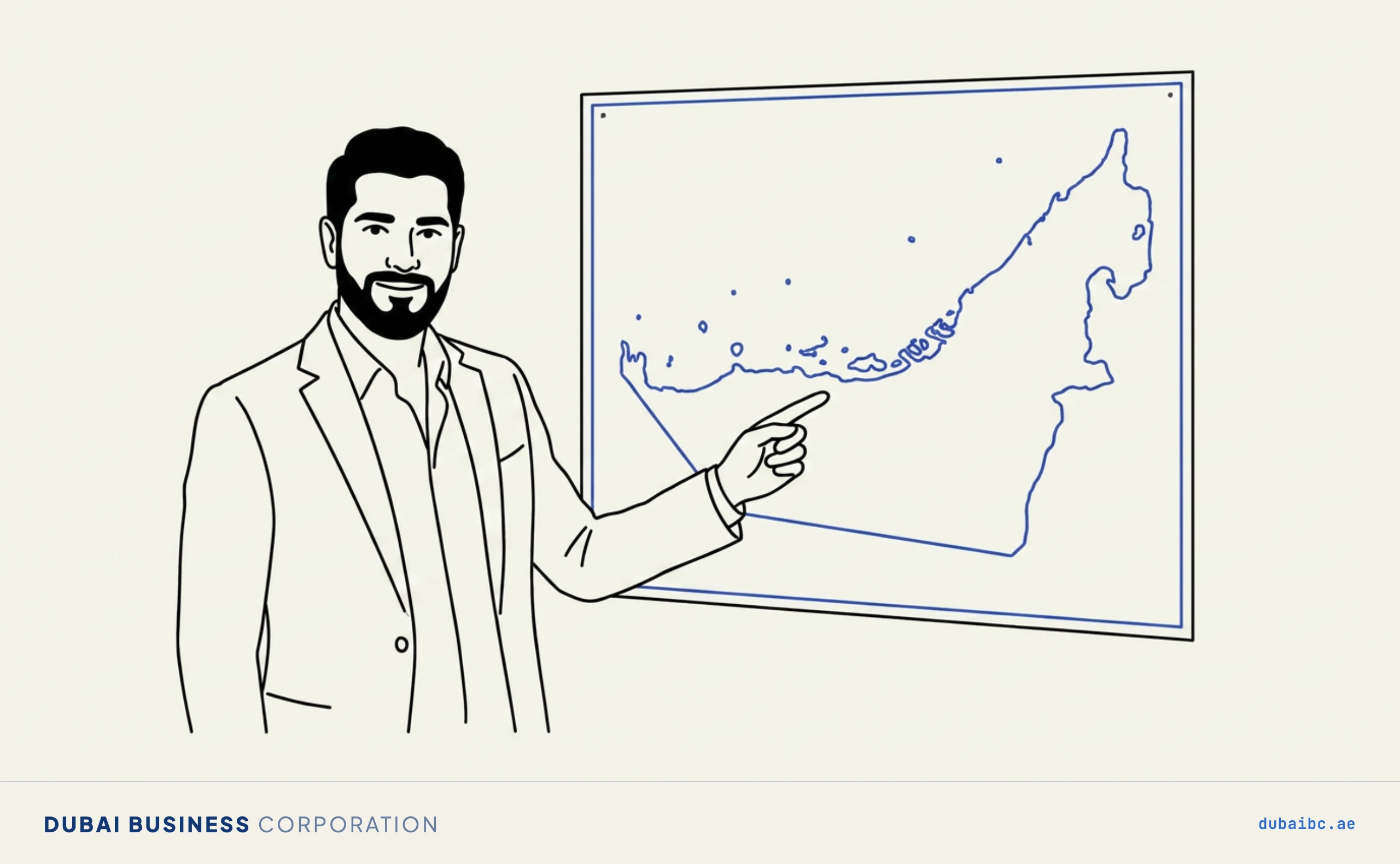
- Dubai. The largest business centre, the widest free zone choice, the strongest banking and the highest costs. Default for most international businesses.
- Abu Dhabi. The capital, government and energy driven, home to ADGM. Strong for regulated finance, government linked work and industry. See Abu Dhabi costs.
- Sharjah. Adjacent to Dubai, meaningfully cheaper, with real industrial and trading activity. See Sharjah costs.
- Ajman. Low cost licensing within commuting distance of Dubai. See Ajman.
- Ras Al Khaimah. Industry, quarrying, ports and cheap land, plus the RAK ICC offshore registry. See RAK.
- Fujairah. East coast, outside the Strait of Hormuz, a global bunkering hub. See Fujairah.
- Umm Al Quwain. The smallest economy and one of the cheapest licences. See UAQ.
What Is Federal and Identical Everywhere
A great deal, and this is where cost comparisons between emirates get misleading. Corporate tax is federal: 0% on the first AED 375,000 of taxable profit and 9% above it, with a 0% rate for a Qualifying Free Zone Person on qualifying income and Small Business Relief available to smaller businesses through the end of 2026.
VAT is federal at 5% with mandatory registration at AED 375,000 of taxable supplies and voluntary registration at AED 187,500.
Immigration, residence visas and Emirates ID run through the federal ICP, with Dubai additionally served by GDRFA. Labour law, work permits and wage protection sit with MOHRE for mainland employers, with free zones applying equivalent regimes.
Compliance obligations including UBO registers, economic substance and anti money laundering rules are national.
So the emirate changes your licence cost, your premises cost and your local market access. It does not change your tax rate, your visa process or your compliance obligations.
The Process, Start to Finish
- Define the activity precisely. Everything downstream depends on it.
- Choose the jurisdiction using the table above, based on where your customers are.
- Choose the emirate and the specific authority or zone.
- Reserve the trade name and take initial approval. See naming rules.
- Arrange premises, from a flexi desk to a warehouse, and register the tenancy where required.
- Complete the incorporation documents, including the memorandum of association where applicable.
- Receive the licence, then the establishment card.
- Apply for residence visas and open the corporate bank account.
- Register for tax where required, including corporate tax registration.
Our step by step Dubai guide walks the same sequence in detail for the most common case.

Price mainland, free zone and offshore side by side with real itemised figures.
What It Actually Costs
Here are real figures from our own price book rather than market estimates. A Sharjah free zone licence such as SPC starts around AED 6,500 with no visas, around AED 14,500 with one, and each additional visa adds about AED 5,000.
A Dubai free zone such as Meydan starts around AED 11,920 with no visas and around AED 21,490 with one, with the first Dubai visa adding about AED 9,570 to the package.
Dubai mainland ranges from roughly AED 17,772 to AED 28,287 depending on activity and structure.
Offshore sits between AED 11,000 and AED 20,000.
Those are complete, itemised numbers, not "starting from" teasers. Price your exact combination with our cost calculator, and read the seven emirates comparison and the first year cost month by month for the full budget picture.
Ownership: The 100% Question
Free zones have always allowed full foreign ownership. Since the 2021 change to the Commercial Companies Law, most mainland activities do too, so the old requirement for a 51% local partner no longer applies across the board.
A defined list of strategic activities still carries restrictions, and some activities require an Emirati agent or specific approvals.
The practical answer is to check your specific activity rather than assume either way. Our guide to 100% foreign ownership explains what changed and what still needs a partner.
Banking, the Step That Decides Your Timeline
Every founder underestimates this. UAE banks assess substance, ownership, source of funds and business rationale, and the process routinely takes longer than incorporation itself.
A company with a clear business, real premises and coherent documentation opens accounts. One with a cheap licence, no office and an opaque structure struggles regardless of emirate.

Plan for it from the start: read how to open a corporate account, prepare the documents, and understand why applications get rejected.
Visas and Residency
A company licence is the normal route to UAE residency for a founder. The company sponsors the visa, the process runs through entry permit, medical, Emirates ID and stamping, and the resulting residence visa is valid across the country regardless of the emirate that issued it.
Family sponsorship follows once you meet the requirements.
For investors and entrepreneurs there are also the investor and partner visa, the Golden Visa for those who qualify, and the freelance visa for individuals working independently.
How to Actually Choose
Answer four questions in order and the decision usually makes itself. Where are your customers physically located?
Do you need premises the public visits? How many residence visas do you need?
And is your activity regulated by a specific authority such as a health, financial or transport regulator?
Customers in the UAE with a shop or clinic means mainland in the emirate where the premises sits. International clients and no public premises means a free zone, chosen on cost and banking rather than on prestige.
Holding assets with no local operations means offshore. A regulated activity means starting with that regulator before choosing anything else.
The Free Zone Landscape
There are more than forty free zones in the UAE, and they fall into recognisable families. Broad multi activity zones such as Meydan, IFZA, RAKEZ and Ajman Free Zone license almost anything and compete largely on price and service.
Sector specific zones exist for commodities, media, healthcare, education, technology and logistics, and they bring an ecosystem of similar businesses along with the licence.
Then there are the financial free zones, DIFC in Dubai and ADGM in Abu Dhabi, which are different in kind.
They operate their own courts and common law based legal systems, and they are the right home for regulated financial services, funds and certain holding structures.
They are not the right home for a small trading company, and their cost structure reflects that.
Our guide to every free zone in the UAE lists them by emirate, and which free zone is best in Dubai works through the choice by business type.
Company Structures Available
Alongside the jurisdiction choice sits the legal form: limited liability company, sole establishment, civil company, branch of a foreign company, representative office, free zone establishment or company, and the various offshore and holding vehicles. Each has different ownership rules, liability consequences and licensing implications.
Most operating businesses end up as an LLC on the mainland or an FZ-LLC in a free zone, and most people never need to think beyond that. Where it matters is for professional practices, foreign companies opening a UAE presence, and groups building holding structures.
Our guide to types of companies in the UAE covers every form, and LLC versus sole establishment handles the most common single decision.
Common Mistakes
- Choosing a zone before defining the activity.
- Buying on licence price without pricing visas and banking.
- Assuming a free zone licence permits mainland retail.
- Expecting an emirate to change your tax position. It will not.
- Using an offshore company when you need to live and operate here.
- Leaving banking to the end, when it is the longest step.
The Verdict
The UAE is genuinely one of the most straightforward places in the world to incorporate, with full foreign ownership, a low tax regime, a functioning residence visa system tied to your company and no shortage of options. The complexity is in the choice, not the process.
Decide from your customers backwards, price the total rather than the headline, and treat banking as a first class consideration rather than an afterthought. Get those three right and the rest is administration.
Frequently asked questions
A mainland licence permits trading freely within its emirate, including retail premises and government contracts, and requires physical premises. A free zone licence gives full foreign ownership and customs benefits but restricts direct trading into the UAE mainland market, usually requiring a distributor or a mainland presence. Free zones typically cost less and allow flexi desk arrangements.
The northern emirates compete at the bottom, with Umm Al Quwain, Ajman and some Fujairah and Sharjah zones offering the lowest packages. From our own price book, a Sharjah free zone licence starts around AED 6,500 with no visas, against about AED 11,920 for a Dubai free zone such as Meydan. Compare total cost including visas rather than headline licence fees.
Yes in free zones, which have always allowed it, and now for most mainland activities too following the 2021 amendment to the Commercial Companies Law. A defined list of strategic activities still carries restrictions and some activities require an Emirati agent or specific approvals, so check your particular activity rather than assuming it applies universally.
No. You can own a UAE company as a non resident, and many owners do, particularly for holding and international trading structures. A residence visa is optional rather than mandatory, though it makes banking, tenancy and day to day administration considerably easier. Offshore companies specifically cannot sponsor residence visas at all.
The licence itself can be issued within days in a straightforward free zone case, and a mainland setup with external approvals takes longer. The realistic constraint is not incorporation but the corporate bank account, which frequently takes weeks and sometimes months depending on the business, its structure and how well the application is prepared.
See the number for your setup
The cost calculator runs on Dubai Business Corporation’s real price book. Answer a few questions and get your total, fully itemised, in under a minute.